google-site-verification=w1K07F0sOED--kR1qgwh-MueJf0CRSjd3TPcL7vRtDk

Why Book an Africa Odyssey Tour ?

Embarking on a guided safari (escorted safari) with Africa Odyssey Safaris and Tours in Namibia offers a rich blend of adventure, education, and cultural exploration. Our professionally guided tours take you through iconic destinations like Etosha National Park and Skeleton Coast, ensuring a memorable and personalised experience.  

Accommodated Safaris

Mobirise Website Builder
Etosha Express

3 days
from N$19,600 (US $1,221)

Mobirise Website Builder
Sossusvlei Express

3 days
from N$19,600 (US $1,221)

Mobirise Website Builder
Etosha & Swakopmund Adventure

4 days
from N$24,200 (US $1,508)

Mobirise Website Builder
Swakopmund & Sossusvlei Adventure

4 days:
from N$24,200 (US $1,508)

Mobirise Website Builder
Dunes & Wildlife

6 days
from N$39,500 (US $2,461)

Mobirise Website Builder
Skeleton Coast and Sossusvlei

6 Days
from N$46,600 (US $2,904)

Mobirise Website Builder
Etosha and Skeleton Coast

6 Days
from N$46,600 (US $2,904)

Mobirise Website Builder
Nambian Highlights

7 Days :
from N$43,800 (US $2,729)

Mobirise Website Builder
Taste of Namibia

7 days
from N$46,800 (US $2,916)

Etosha Express

Starts: Windhoek - Ends: Swakopmund
3 days
from N$19,600 (US $1,221)

Departures on this 3-day and 2-night accommodated adventure are from Windhoek every Tuesday and Thursday, this itinerary is a fantastic way quickly to ‘’Snapshot’’ three of Namibia’s greatest highlights.

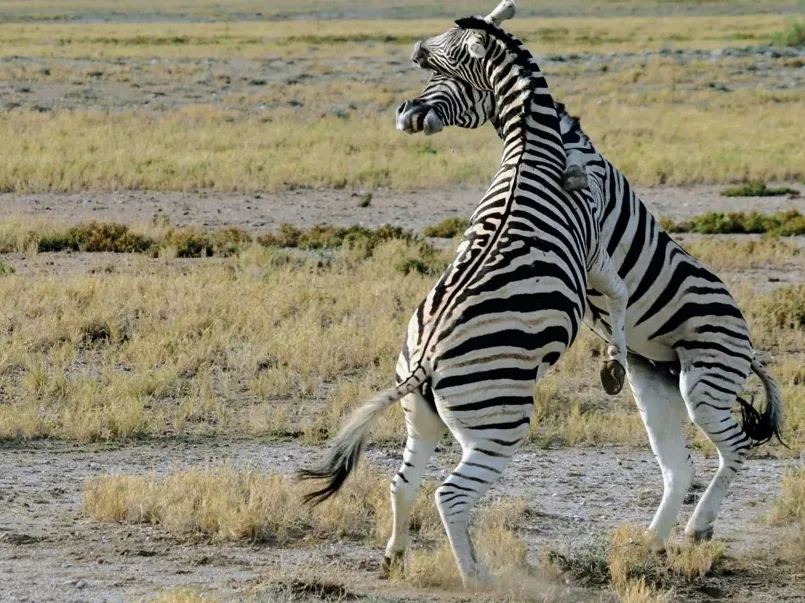
Amazing wildlife opportunities abound in Etosha National Park where in many cases the animals come to us as we seek out the myriad of waterholes. We are looking for predators and prey alike, lion and leopard, elephant and giraffe, black rhino and eland are all in the mix of possible sightings, together with so many more species of mammal and birds that it is impossible to mention them all.

The mineral pan ‘’The Great White Space’’ from which Etosha takes its name is 22,000 square km of desolate, dazzling expanse, so big it can be seen from space.

Beautiful Damaraland gives us a unique ‘’Big Sky’’ experience, where the towering pink granite koppies seem to touch the very sky on our horizon. Stunning in every season, this region of mountains and grassland, trees and riverbeds, desert elephant and desert rhino, puts real meaning into the words ‘’breathtaking.

We meet some of the locals as we travel through Damaraland, Himba, Herero & Damara people, often in traditional dress, who welcome us to their makeshift roadside stalls where they sell traditional hand crafts to the passing traffic. Onwards, westward, passing under the shadow of Namibia’s highest mountain, The Brandberg, we make our way down to the Atlantic Ocean.

Reaching the wild and rugged Skeleton Coast, we follow the ocean road into the unusual and quirky town of Swakopmund. Referred to by some as the adrenaline capital of Namibia, there are certainly some hair-raising experiences on offer, but Swakopmund is also a place where you can relax and recharge


Day 1: Windhoek – Accommodation inside Etosha National Park – 500 km
You will be collected from your accommodation within the Windhoek city limits at 07:00 and transferred to Chameleon Headquarters for a short pre-departure meeting.

Heading north from Windhoek, we stop briefly at the small town of Otjiwarongo to gather some last-minute supplies before continuing on to Etosha, and we enjoy a light lunch pack whilst “on the move”. We enter Etosha National Park and game drive our way to our overnight accommodation.
Etosha is huge, just over 22,000 square km and is home to 114 species of mammal, 350 species of bird, 110 species of reptile, uncountable numbers of insects and, somewhat bizarrely, one species of fish. There are good chances of spotting many of these different creatures as we tour through the park, stopping at the various waterholes along our way.

All visitors must be in camp by sunset, and we aim to arrive at our lodge just before sunset and with time to settle into our rooms, with en-suite bathroom and tea/coffee facilities.

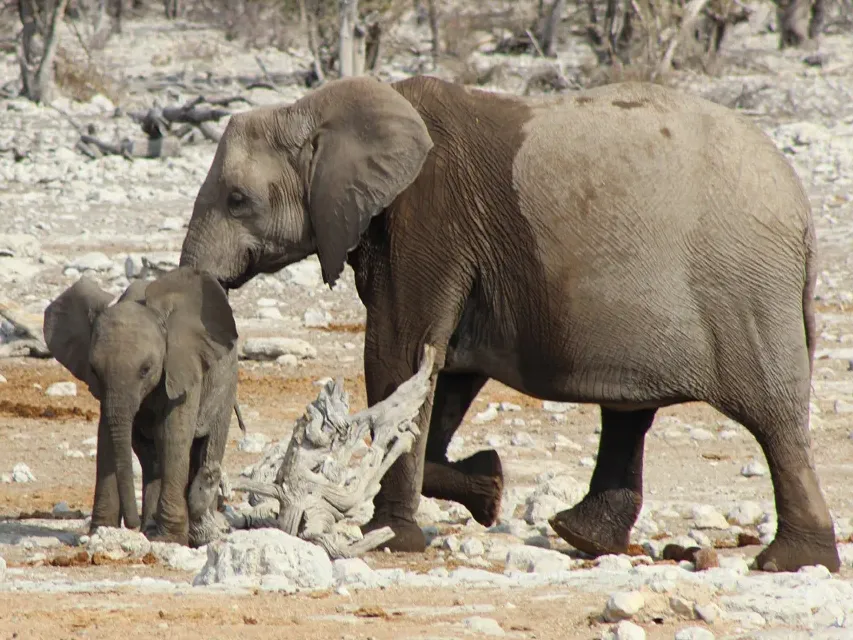
The ‘game show’ in Etosha doesn’t stop when the sun goes down. All the Etosha camps have floodlit waterholes for extra game viewing opportunities. The floodlit waterhole is located within walking distance of our accommodation. A visit, or two, is highly recommended this evening as we can expect many species to visit the waterhole during the night, and this waterhole is known to be very popular with elephants and the critically endangered black rhino.

Accommodation: Twin share, en-suite bathroom (Okaukuejo or Halali Lodge inside the park)
Meals: Lunch, Dinner

Day 2: Etosha – Accommodation near Anderson gate – 70 km
We have the whole day to explore Etosha in an open game viewer, and we want to make the most of it. We enjoy an early breakfast and then start our day. Early morning is usually a productive time for game viewing, and the first thing in the morning is a good time to catch big cats returning from their hunts.

Etosha is a desert landscape, and water is the most scarce natural resource. There are, however, numerous waterholes here, both natural and man-made, and our game-driving technique is to take in as many of these as possible. Here, we hope that the game will come to us as thirsty animals come for a much-needed drink.
On our way today, we will stop to have a closer look at the Etosha Pan. The name Etosha translates as ‘great white space’, but this name does not do justice to the immensity of the pan. Over 4,700 square km of dazzling white mineral pan, so big that it can be seen from space.

We exit Etosha at the Anderson Gate, just in time for sunset, and it’s a short drive to our accommodation, which features a comfortable, spacious twin-share room with modern en-suite bathroom facilities. An ideal space to sit back, relax and enjoy the beauty that surrounds you. A fantastic dinner tonight.

Accommodation: Twin share, en-suite bathroom
Meals: Breakfast, Lunch, Dinner (Lodges we use: Etosha Village, and Okatula Etosha Lodge)

Day 3: Etosha – Swakopmund – 510 km
After breakfast, we aim to be on the road by 7:30 this morning. We are heading for the Skeleton Coast, and we are taking the scenic route. We first head south on the main road, passing the small town of Outjo, and then continue west, picking up the gravel road as we travel through the area known as Damaraland.

Damaraland is famed for its scenery, mountains, open grasslands, tall koppies, (small hills), of round pink granite boulders, wide open spaces and big sky. We also have the opportunity to meet some of the locals, as there are several places along our route today where we can find informal shops selling locally made, handcrafted souvenirs. Represented here are ladies from the Himba, Herero, and Damara tribes, and most often, they are wearing their traditional attire. Here we can interact with some of the colourful local characters who live in this harsh environment. Making a small purchase here is a good way to inject some cash directly into the local economy.

We continue on through the beautiful landscape, making a stop for a light picnic lunch, under the shadow of Namibia’s highest mountain, the Brandberg. Rising from the desert floor, this giant monolith is 2,573 m above sea level and is formed of pink-tinted granite.
We continue our journey west and soon arrive at the coast and the chilly Atlantic Ocean. The whole coastline of Namibia is known as the Skeleton Coast, and it is easy to see why this barren seaboard is so named, with its forbidding mountains and barren beaches. The wind, the waves and the huge fog banks all conspire to push ships onto the beach. The countless mariners who, in olden times, found themselves shipwrecked here faced the stark prospect of no fresh water, no food, no rescue and a slow death by exposure. Their Shipmates who went down with their ship were thought to be the lucky ones.

Heading south on the coast road, our next stop is a more recent shipwreck. 15 km south of the small town of Henties Bay, a fishing trawler, The Zeila, was beached in 2008. She was an old vessel that had been sold for scrap and was under tow at the time. The cable snapped, and, like so many vessels before her, she was caught in the swell and currents and ended up on the beach. She lies quite close to the shore and is well-positioned for photos.

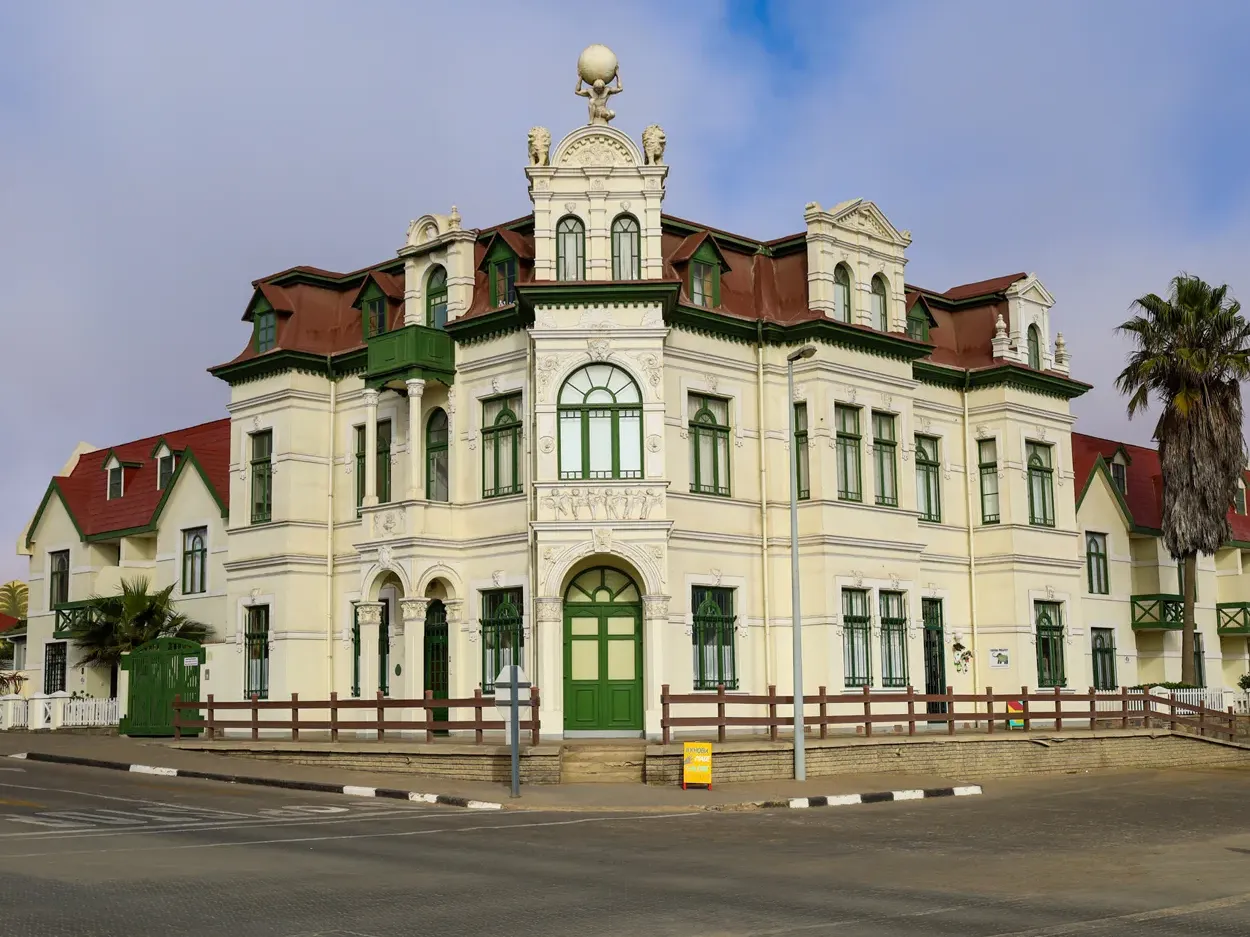
Swakopmund was founded by Captain Kurt von François of the imperial colonial army of the German Empire in 1892. (He also founded Windhoek in 1890.) It is an interesting town to say the least, bounded to the north, the east and the south by the mighty dunes of the Namib Desert and to the west by the Atlantic Ocean. There are still many examples of colonial German architecture to be seen, and the German language is still widely used.

You will be dropped off at your accommodation anywhere within the Swakopmund city limits. Swakopmund boasts some truly excellent restaurants, and again, your guide will be able to help you with recommendations and bookings.

Accommodation: None
Meals: Breakfast, Lunch,

Includes:
• Transport in a safari vehicle with A/C
• English-speaking guide
• 2 nights’ accommodation
• Meals (B x2, L x3, D x2)
• National Park entry fees
• 1/2 day game drive in Etosha in the Chameleon Safaris vehicle
• full day game drive in an open game viewer
• Pick up within Windhoek city limits and drop off within Swakopmund city limits
• Tap Water
• Shared airport shuttle to and from the Windhoek International Airport

Pickup info: Pick up from the accommodation starts at 7:00 the morning of departure

Other Info:
Bookings are made on a twin share basis, single supplement is available for solo travellers that prefer their own room


Sossusvlei Express

Starts: Swakopmund - Ends: Windhoek
3 days
from N$19,600 (US $1,221)

Departing from the coastal town of Swakopmund, this 3 day; two night accommodated safari will take you on a magical trip to one of the most beautiful places on Planet Earth, the centre of the Namib – the oldest desert in the world. From the coast, we cross the vast gravel plains that stretch inland for over 100km. We traverse high mountain passes and cross The Tropic of Capricorn on our way down to the dune fields. A pre-dawn start to catch the soft light of sunrise as we head for Dead Vlei with its stark collection of skeleton trees and on to Sossusvlei, water’s end of an ancient river. We watch out for wildlife, oryx and springbok are often seen in this sandy land but if we look and have sharp eyes, the dunes are also home to a full menagerie of reptiles, beetles, insects, rodents and birds. All these creatures are uniquely desert adapted, survive in this waterless wonderland using super-power evolutionary adaptations. The Namib Desert is internationally recognised as a top biodiversity hot spot in a desert habitat. Climbing a towering dune, 300 m from top-to-toe, is an experience unique to Namibia, Big Daddy, Big Mamma and Dune 45 are all waiting to be conquered if you are feeling intrepid and want to experience the view from such a lofty perch. We visit the Solitaire cheetah conservation project, then homeward-bound up-and-over Rocky Mountains as we climb our way up the central plateau and across the Khomas Hochland mountains to Windhoek

Day 1: Swakopmund – Accommodation, near Sesriem – 350 km
There is the option of a leisurely start this morning, as we are only leaving Swakopmund in the late morning. Your guide will collect you from your provided accommodation at 11h00 today.

If you choose not to have a lie-in, then Swakopmund offers many opportunities to keep us busy during our morning here. The town centre is small and easily explored on foot, but there are also many extra, optional activities available. For those with a love of adrenaline, quad biking and sandboarding are very popular if you fancy careering down the slip face of a dune at 60 km per hour.

Departing Swakopmund at 11h30, we head east into the desert. We first cross the Namib gravel plains, large areas of flat and seemingly barren terrain broken up by huge mountain inselbergs. We have two mountain passes to traverse this afternoon, the first is the mighty Kuiseb Pass, and we follow the road from the top of the mountains, dropping steeply down into the canyon carved over aeons by the Kuiseb River on its way to debouch into the ocean at the port town of Walvis Bay.

Furthermore, we climb up from the banks of the river and over the pass, travelling through the mountain peaks and on to the second, smaller canyon of the Gaub River, a tributary of the Kuiseb. We emerge from the mountains onto a flat road, and almost immediately we cross the Tropic of Capricorn at 23.5 degrees south. There is a signpost at this auspicious spot, and we stop along the road for photos. Onwards again to our destination for today. We aim to arrive in the late afternoon, and there will be time for a short walk to see the sun dip below the impressive Naukluft Mountains.

Accommodation: Twin share, en-suite bathroom (Preferred lodges: Desert Camp, Namib Desert Lodge, Weltevrede and Hammerstein Lodge)
Meals: Lunch, Dinner

Day 2: Sossusvlei – 120 km
Getting into the dune area as early as possible this morning is our aim, and that means a pre-dawn start and breakfast on the go. As we are staying outside the national park, we will enter the dune area as soon as the gate opens at sunrise.

The best time to photograph the dunes is the early morning hours. This is when you can see towering dunes illuminated a glowing orange, apricot red on one side and swathed in shadow on the other. The depth of field is spectacular at this time of day. From Sesriem, we cover the 60 km into the dunes quickly and arrive at the 2×4 car park where all 2-wheel drive vehicles have to stop. From here we enter the ancient Tsauchab River-bed for the last 5km leg to Sossusvlei itself.

The Tsauchab River is ephemeral; it only flows seasonally, when there is enough rain, and for the most part, the riverbed is dry. Aeons ago, during these rare floods, the Tsauchab sometimes received enough water to flow all the way to the Atlantic Ocean. However, as the millennia passed and the dune fields began to form (around five million years ago), wind-blown sand invaded the riverbeds. The rivers became more and more constricted by sand, until eventually the occasional floods could not break through the sand barriers that had been erected by the wind. The valley we drove along this morning to get here is kept free of sand by the Tsauchab, but Sossusvlei is now permanently water’s end.

Sossusvlei does still sometimes flood (perhaps once in a decade). After good rains in the Naukluft Mountains, where the river rises, Sossusvlei can become inundated, and the lake that this creates can last for many months, but no longer can the river find its original path to the Atlantic.

There is a 4×4 shuttle service that will transport us through the sandy terrain of the riverbed. We will visit Dead Vlei, an ancient pan surrounded by dunes, that is strikingly populated with dead, skeletal camel thorn trees. These trees have been a feature of this landscape for over 1000 years. Sossusvlei is almost surrounded by dunes, just one narrow path kept open by the Tsauchab River. We have time to explore the area on foot and to climb one of the highest dunes in the world, some towering 300 m above us, the views are breathtaking and justly famous.

We drive back the way we came (there is only one road), stopping at the iconic Dune 45 (so named as it is 45 km from Sesriem. There is time to climb Dune 45 if you still have energy, or perhaps just sitting in the shade at the base of the dune will suffice.

Driving back to Sesriem, we take a short excursion to see the Sesriem Canyon. Only four km from Sesriem, this canyon has been carved out of the landscape by the Tsauchab River. Around two million years ago, there was an ice age in Europe. This caused glaciers to form and resulted in a worldwide drop in sea level. The knock-on effect of this at Sesriem Canyon was that it increased the length and water flow of the Tsauchab River. This greater force of water allowed the Tsauchab to begin cutting through the terrain, resulting in the canyon we can see today. We can easily walk into the riverbed, it is usually much cooler in the canyon, and we can follow the river for some way along its journey to Sossusvlei.
We head back to our accommodation in the late afternoon.

Accommodation: Twin share, en-suite bathroom (Preferred lodges: Desert Camp, Namib Desert Lodge, Weltevrede and Hammerstein Lodge)
Meals: Breakfast, Lunch, Dinner

Day 3: Namib Desert– Windhoek – 320 km
Today is our last day, but excitement is still on the menu. We head back to Solitaire, where our guide will get us a sample of the apple pie that has made this homestead famous.

There is some lovely mountain scenery on our drive back to Windhoek. The road climbs up onto and over Namibia’s central plateau, and we return to Windhoek via the small community of BűellsPort and the small town of Rehoboth. We arrive mid-afternoon and will be dropped at the accommodation of our choice within Windhoek city limits.

For those that choose to fly today, NO FLIGHTS DEPARTING BEFORE 19H00 in case there are unexpected delays returning from safari.

Includes:
• Transport in a safari vehicle with A/C
• Professional English-speaking Guide
• 2 nights’ accommodation
• Meals (B x2, L x2, D x2)
• National Park entry fees
• Guided excursion to Sossusvlei
• Pick up within Swakopmund city limits and drop off within Windhoek city limits
• Shared Airport shuttle to and from Windhoek International Airport (HKIA)
• Tap Water

Pickup info: Pick up from accommodation in Swakopmund starts at 11h00 on the morning of departure

Other Info:
Bookings are made on a twin share basis, single supplement is available for solo travellers that prefer their own room 


Etosha & Swakopmund Adventure

Starts Windhoek - Ends Windhoek
4 days
from N$24,200 (US $1,508)

Departures on this 4 day and 3 night accommodated adventure are from Windhoek every Tuesday and this itinerary is a fantastic way quickly to ‘’Snapshot’’ three of Namibia’s greatest highlights.

Amazing wildlife opportunities abound in Etosha National Park where in many cases the animals come to us as we seek out the myriad of waterholes. We are looking for predators and prey alike, lion and leopard, elephant and giraffe, black rhino and eland are all in the mix of possible sightings together with so many more species of mammal and birds that it is impossible to mention them all.

The mineral pan ‘’The Great White Space’’ from which Etosha takes its name is 22,000 square km of desolate, dazzling expanse, so big it can be seen from space.

Beautiful Damaraland gives us a unique ‘’Big Sky’’ experience, where the towering pink granite koppies seem to touch the very sky on our horizon. Stunning in every season this region of mountains and grassland, trees and riverbeds, desert elephant and desert rhino, puts real meaning into the words ‘’breath taking’’.

We meet some of the locals as we travel through Damaraland, Himba, Herero & Damara people, often in traditional dress, welcome us to their makeshift roadside stalls where they sell traditional handcrafts to the passing traffic. Onwards, westward, passing under the shadow of Namibia’s highest mountain, The Brandberg, we make our way down to the Atlantic Ocean.

Reaching the wild and rugged Skeleton Coast, we follow the ocean road into the unusual and quirky town of Swakopmund. Referred to by some as the adrenaline capital of Namibia, there are certainly some hair-raising experiences on offer, but Swakopmund is also a place where you can relax and recharge.

Walvis Bay Lagoon, an internationally recognised Ramsar site wetland, is home to spectacular flamingo flocks before heading back to the city and journeys end

Day 1: Tuesday Windhoek – Etosha National Park – 500 km
You will be collected from your accommodation within the Windhoek city limits at 07:00 and transferred to Chameleon Headquarters for a short pre-departure meeting.

Heading north from Windhoek, we stop briefly at the small town of Otjiwarongo to gather some last-minute supplies before continuing to Etosha, and we enjoy a light lunch pack whilst “on the move”. We enter Etosha National Park and embark on a game drive to our overnight accommodation.
Etosha is huge, spanning just over 22,000 square kilometres and home to 114 species of mammal, 350 species of bird, 110 species of reptile, countless numbers of insects, and, somewhat bizarrely, one species of fish. There are good chances of spotting many of these different creatures as we tour through the park, stopping at the various waterholes along the way.
All visitors must be in camp by sunset. We aim to arrive at our lodge before sunset, allowing time to settle into our rooms, which feature en-suite bathrooms. Dinner is at the camp restaurant tonight.

The ‘game show’ in Etosha doesn’t stop when the sun goes down. All the Etosha camps have floodlit waterholes for extra game viewing opportunities. The waterhole is located near our accommodation. A visit, or two, is highly recommended this evening, as we can expect many species to visit during the night. This waterhole is renowned for its popularity with elephants and the critically endangered black rhino.

Accommodation: Twin share, en-suite bathroom ( Okaukeujo or Halali Resort inside the park)
Meals: Lunch, Dinner

Day 2: Wednesday Etosha-Accommodation near Anderson gate – 70 km
We have the whole day to explore Etosha in an open game viewer, and we want to make the most of it. We enjoy an early breakfast and then start our day.. Early morning is usually a productive time for game viewing, and first thing in the morning is a good time to catch big cats returning from the hunt.

Etosha is a desert landscape, and water is the most scarce natural resource. There are, however, numerous waterholes here, both natural and man-made, and our game-driving technique is to take in as many of these as possible. Here, we hope that the game will come to us as thirsty animals come for a much-needed drink.

On our way today, we will stop to have a closer look at the Etosha Pan. The name Etosha translates as ‘great white space’, but this name does not do justice to the immensity of the pan. Over 4,700 square km of dazzling white mineral pan, so big that it can be seen from space.

We exit Etosha at the Anderson gate, close to sunset, and it is just a short drive to our accommodation, which features a comfortable, spacious twin-share room with modern en-suite bathroom facilities. An ideal space to sit back, relax and enjoy the beauty that surrounds you. A fantastic dinner tonight.

Accommodation: Twin share, en-suite bathroom ( Etosha Village, Etosha Okutala Lodge)
Meals: Breakfast, Lunch, Dinner

Day 3: Thursday Etosha – Swakopmund, Hotel A La Mer – 510 km
After breakfast, we aim to be on the road by 7:30 this morning. We are heading for the Skeleton Coast, and we are taking the scenic route. We first head south on the main road, passing the small town of Outjo, and then continue west, picking up the gravel road as we travel through the area known as Damaraland.

Damaraland is renowned for its stunning scenery, majestic mountains, vast open grasslands, and tall koppies (small hills) of rounded pink granite boulders, as well as its expansive landscapes and vast blue skies. We also have the opportunity to meet some of the locals, as there are several places along our route today where we can find informal shops selling locally made, handcrafted souvenirs. Represented here are ladies from the Himba, Herero, and Damara tribes, and most often, they are wearing their traditional attire. Here we can interact with some of the colourful local characters who live in this harsh environment. Making a small purchase here is a good way to inject some cash directly into the local economy.

We continue through the beautiful landscape, making a stop for a light picnic lunch, under the shadow of Namibia’s highest mountain, the Brandberg. Rising from the desert floor, this giant monolith is 2,573 m above sea level and is formed of pink-tinged granite. We continue our journey west and soon arrive at the coast and the chilly Atlantic Ocean. The whole coastline of Namibia is known as the Skeleton Coast, and it is easy to see why this barren seaboard is so named, with its forbidding mountains and barren beaches. The wind, the waves and the huge fog banks all conspire to push ships onto the beach. The countless mariners who, in olden times, found themselves shipwrecked here faced the stark prospect of no fresh water, no food, no rescue and a slow death by exposure. Their Shipmates who went down with their ship were thought to be the lucky ones.

Heading south on the coast road, our next stop is a more recent shipwreck. 15 km south of the small town of Henties Bay, a fishing trawler, The Zeila, was beached in 2008. She was an old vessel that had been sold for scrap and was under tow at the time. The cable snapped, and, like so many ships before her, she was caught in the swell and currents and ended up stranded. She lies pretty close to the shore and is well-positioned for photos.

We complete the final leg of our journey to Swakopmund, check into our accommodation, the centrally located A La Mer hotel, and the town is easily explored on foot from our central location. Swakopmund was founded by Captain Kurt von François of the German Empire’s imperial colonial army in 1892. (He also founded Windhoek in 1890). It is an interesting town to say the least, bounded to the north, the east and the south by the mighty dunes of the Namib Desert and to the west by the Atlantic Ocean. There are still many examples of colonial German architecture to be seen, and the German language remains widely spoken.
Swakopmund boasts some truly excellent restaurants, and again, your guide will be able to provide recommendations and assist with bookings.

Accommodation: Twin share, en-suite bathroom
Meals: Breakfast, Lunch,

Day 4: Friday Swakopmund – Walvis Bay – Swakopmund – Windhoek – 420 km
We have a more leisurely start this morning, and a lie-in, a big breakfast and a wander around town are the order of the day. There are some great curio shops, excellent bookstores, and an authentic café culture is thriving here, with plenty of small eateries serving delicious food. Later in the morning, we visit the Walvis Bay lagoon.

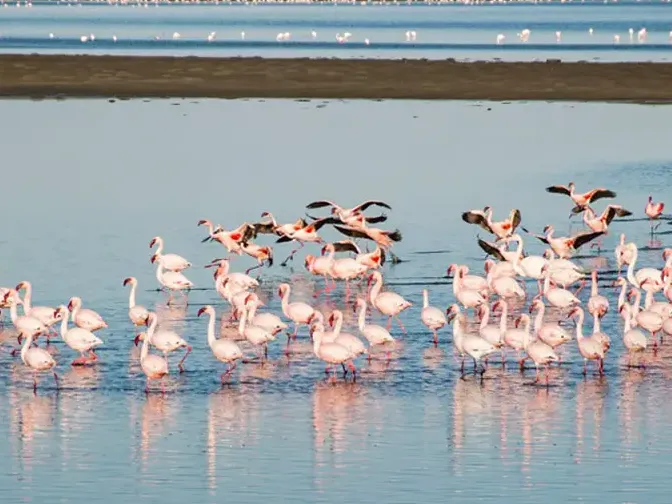
Just 40 km along the coast to the south, Walvis Bay (Whale Bay) lagoon is an internationally recognised Ramsar site (Convention on Wetlands of International Importance Especially as Waterfowl Habitat). It is justly renowned for its birdlife, particularly flamingos, which are usually abundant and can be found within easy photographic distance from the shore.
There are two types of flamingo to see, lessor and greater, and they accumulate here because Namibia’s Atlantic coast is abundant with both phytoplankton and zooplankton. Flamingos do not enjoy a solid diet; they live on microorganisms such as plankton, and they are filter feeders, much like oysters. They rinse the seawater through their beaks, and tiny filaments filter out the nutrients as it swishes by. Flamingos are unable to eat unless their heads are fully inverted, and, while feeding, they walk around in a circle, stirring the sand and mud with their feet to release the nutrients. Certain types of these microorganisms turn reddish-pink when they die, which accounts for the pink colour of the birds.

Flamingos do not breed in Walvis Bay. The tides here are not usually very steep, but occasional spring tides can bring deeper waters, and this is not suitable for the specialised nest constructed by the birds. Flamingos build a nest, called a cone, out of sand and mud, which has a hollow top into which they lay a single egg. This cone is designed to keep the egg out of the water, and so a tidal environment does not work. Instead, huge flocks of birds typically head for the Etosha Pan or the Makgadikgadi Pan in Botswana for breeding. Both these mineral pans are seasonal and are usually dry, but can flood when there is sufficient rain. It is still not fully understood how flamingos determine when there has been suitable rainfall in these relatively distant catchment areas. Still, somehow they do know, and they leave the coast in great flocks that streak the horizon pink as they head inland.

Heading back to Swakopmund, we then take the main tar road back to Windhoek. We will have a light lunch en route, and upon arrival in Windhoek, you will be dropped off at your accommodation, located anywhere within the Windhoek city limits.

Accommodation: None
Meals: Breakfast & lunch

• Transport in a safari vehicle with air conditioning and charging ports
• Professional English-speaking guide
• 3 nights’ accommodation
• Meals (B x3, L x4, D x2)
• National Park entry fees
• 1/2 day Game drive in Etosha in the Chameleon Safaris vehicle
• Full-day game drive in an open game viewer
• Visit to Walvis Bay Lagoon
• Pick up & drop off at accommodation within Windhoek city limits
• Shared airport shuttles to and from Windhoek International Airport (HKIA)
• Tap water


Pickup info: Pick up from accommodation in Windhoek starts at 7h00 on the morning of departure

Other Info:
Bookings are made on a twin share basis, single supplement is available for solo travellers that prefer their own room 

Swakopmund & Sossusvlei Adventure

Starts Windhoek - Ends Windhoek
4 days:
from N$24,200 (US $1,508)

Departing on Thursdays from Windhoek, this 4-day and three-night accommodated safari is the perfect way to experience Swakopmund on the Skeleton Coast and the stunning dunes of the Namib Desert. The Ramsar Site at Walvis Bay and the big dunes. Big Daddy, Big Mamma and the iconic Deadvlei

Relaxation or thrills and spills in Swakopmund – the choice is yours. Then, head for adventure on a magical trip to one of the most beautiful places on Planet Earth, the centre of the Namib – the world’s oldest desert. From the coast, we cross the vast gravel plains that stretch inland for over 100km. We traverse high mountain passes and cross the Tropic of Capricorn on our way down to the dune fields.

A pre-dawn start to catch the soft light of sunrise as we head for Dead Vlei with its stark collection of skeleton trees, and on to Sossusvlei, the water’s end of an ancient river. We watch out for wildlife; oryx and springbok are often seen in this sandy land, but with sharp eyes, the dunes are also home to a whole menagerie of reptiles, beetles, insects, rodents, and birds. All these creatures are uniquely adapted to survive in this waterless wonderland, utilising super-powerful evolutionary adaptations. The Namib Desert is internationally recognised as a top biodiversity hotspot in a desert habitat. Climbing a towering dune, 300 m, is an experience unique to Namibia. Big Daddy, Big Mamma and Dune 45 are all waiting to be conquered if you are feeling intrepid and want to experience the view from such a lofty perch. We visit Solitaire, then head homeward, travelling up and over rocky mountains as we climb our way up the central plateau and across the Khomas Hochland mountains to Windhoek

Day 1: Thursday Windhoek – Hotel A La Mer, Swakopmund – 420 km
You will be collected from your accommodation within the Windhoek city limits at 07:15 and transferred to Chameleon Safaris Head Office for a short pre-departure meeting.
We first drive north via the small town of Okahandja, but soon we head west, past the tiny centres of Karibib and Usakos, to the port town of Walvis Bay. The edge of Africa and the Skeleton Coast. Walvis Bay lagoon is an internationally recognised Ramsar site (Convention on Wetlands of International Importance Especially as Waterfowl Habitat) and is justly renowned for its birdlife. Flamingo, pelican, African oyster catcher and turnstone, to name but a few of the more than 50 bird species occurring here. This, along with other aquatic fauna, including bottlenose and Heaviside dolphins, humpbacked and southern right whales, ocean sunfish, and Cape fur seals, all add up to make Walvis Bay lagoon a wetland wonderland.

In particular, we are here to see the flamingos, which are usually abundant and found within easy photo distance from the shore. There are two types of flamingo to see, lessor and greater, and they accumulate here because Namibia’s Atlantic coast is abundant with both phytoplankton and zooplankton. Flamingos do not enjoy a solid diet; they live on microorganisms such as plankton and are filter feeders, much like oysters. They rinse the seawater through their beaks, and tiny filaments filter out the nutrients as it swishes by. Flamingos are unable to eat unless their heads are fully inverted, and, while feeding, they walk around in a circle, stirring the sand and mud with their feet to release the nutrients. Certain types of these microorganisms turn reddish-pink when they die, which accounts for the pink colour of the birds.

Flamingos do not breed in Walvis Bay. The tides here are not usually very steep, but occasional spring tides can bring deeper waters, and this is not suitable for the specialised nest constructed by the birds. Flamingos build a nest, called a cone, out of sand and mud, which has a hollow top into which they lay a single egg. This cone is designed to keep the egg out of the water, and so a tidal environment does not work. Instead, vast flocks of birds typically head for the Etosha Pan or the Makgadikgadi Pan in Botswana for breeding. Both these mineral pans are seasonal and are usually dry, but can flood when there is sufficient rain. It is still not fully understood how flamingos determine when there has been suitable rainfall in these relatively distant catchment areas. Still, somehow they do know, and they leave the coast in great flocks that streak the horizon pink as they head inland.

We complete the final leg of our journey to Swakopmund and check into our accommodation at the centrally located Hotel A La Mer. Swakopmund is a fascinating place, to say the least, founded by Captain Kurt von François of the Imperial German colonial army in 1892. (He also founded Windhoek in 1890). It is bounded to the north, the east and the south by the mighty dunes of the Namib Desert and to the west by the Atlantic Ocean. There are still many examples of colonial German architecture to be seen, and the German language remains widely spoken. Swakopmund offers numerous opportunities to keep us busy during our stay. The town centre is small and easily explored on foot, but there are also many extra, optional activities available. Scenic flights over the desert are very popular, and for the more adventurous, consider trying skydiving or quad biking over and within the Namib dunes. Our guide will discuss all the options with you in advance and will be able to facilitate any bookings that we would like to make.

Dinner tonight is for your own account. Swakopmund boasts some truly excellent restaurants, and again, our guide will be able to help you with recommendations and bookings.

Accommodation: Twin share rooms, en-suite bathroom
Meals: Lunch

Day 2: Friday Swakopmund – Accommodation, near Sesriem – 350 km
We have the option to have a more leisurely start this morning, as we are only leaving Swakopmund in the mid-morning. If you choose not to have a lie-in, then Swakopmund offers many opportunities to keep us busy during our morning here. The town centre is small and easily explored on foot, but there are also many extra, optional activities available. For those with a love of adrenaline, quad biking and sandboarding are also very popular if you fancy careering down the slip face of a dune at 60 km per hour. Our guide will discuss all the options with you in advance and will be able to facilitate any bookings that we would like to make.

Departing Swakopmund at 11h30, we head east into the desert. We first cross the Namib gravel plains, large areas of flat and seemingly barren terrain broken up by huge mountain inselbergs. We have two mountain passes to traverse this afternoon, the first is the mighty Kuiseb Pass, and we follow the road from the top of the hills, dropping steeply down into the canyon carved over aeons by the Kuiseb River on its way to debouch into the ocean at the port town of Walvis Bay. We climb up from the banks of the river and over the pass, travelling through the mountain peaks and on to the second, smaller canyon of the Gaub River, a tributary of the Kuiseb. We emerge from the mountains onto a flat road, and almost immediately we cross the Tropic of Capricorn at 23.5 degrees south. There is a signpost at this auspicious spot, and we stop along the road for photos. Onwards again to our destination for today. We aim to arrive in the late afternoon, and there will be time for a short walk to see the sun dip below the impressive Naukluft Mountains.

Accommodation: Twin share, en-suite bathroom (Desert Camp, Desert Quiver Camp)
Meals: Breakfast, Lunch, Dinner

Day 3: Sossusvlei – 120 km
Getting into the dune area as early as possible this morning is our aim, and that means a pre-dawn start and breakfast on the go. As we are staying outside the national park, we will enter the dune area as soon as the gate opens at sunrise.
The best time to photograph the dunes is around sunrise and sunset. This is when you can see towering dunes illuminated a glowing orange, apricot red on one side and swathed in shadow on the other. The depth of field is spectacular at this time of day. From Sesriem, we cover the 60 km into the dunes quickly and arrive at the 2×4 car park where all 2-wheel drive vehicles have to stop. From here, we enter the ancient Tsauchab River-bed for the last 5km leg to Sossusvlei itself.

The Tsauchab River is ephemeral; it only flows seasonally, when there is enough rain, and for the most part, the riverbed is dry. Aeons ago, during these rare floods, the Tsauchab sometimes received enough water to flow all the way to the Atlantic Ocean. However, as the millennia passed and the dune fields began to form (around five million years ago), wind-blown sand invaded the riverbeds. The rivers became more and more constricted by sand, until eventually the occasional floods could not break through the sand barriers that the wind had erected. The valley we drove along this morning to get here is kept free of sand by the Tsauchab, but Sossusvlei is now at the end of the water. Sossusvlei still occasionally floods (perhaps once every decade). After good rains in the Naukluft Mountains, where the river originates, Sossusvlei can become inundated, and the resulting lake can persist for many months. However, the river can no longer find its original path to the Atlantic.

There is a 4×4 shuttle service that will transport us through the sandy terrain of the riverbed. We will visit Dead Vlei, an ancient pan surrounded by dunes, which is strikingly populated with dead, skeletal camel thorn trees. These trees have been a feature of this landscape for over 1000 years. Sossusvlei is almost surrounded by dunes, just one narrow path kept open by the Tsauchab River. We have time to explore the area on foot and to climb one of the highest dunes in the world, some towering 300 m above us; the views are breathtaking and justly famous. We drive back the way we came (there is only one road), stopping at the iconic Dune 45 (so named as it is 45 km from Sesriem. There is time to climb Dune 45 if you still have energy, or sitting in the shade at the base of the dune will suffice.

Driving back to Sesriem, we take a short excursion to see the Sesriem Canyon. Only four km from Sesriem, this canyon has been carved out of the landscape by the Tsauchab River. Approximately two million years ago, a period of intense cold known as an ice age occurred in Europe. This caused glaciers to form and led to a global decline in sea level. The knock-on effect of this at Sesriem Canyon was that it increased the length and water flow of the Tsauchab River. This greater force of water allowed the Tsauchab to begin cutting through the terrain, resulting in the canyon we can see today. We can easily walk into the riverbed, it is usually much cooler in the canyon, and we can follow the river for some way along its journey to Sossusvlei. We head back to our accommodation in the late afternoon.

Accommodation: Twin share, en-suite bathroom (Desert Camp, Desert Quiver Camp)
Meals: Breakfast, Lunch, Dinner

Day 4: Sunday – Windhoek – 320 km
Today is our last day, but excitement is still on the menu. We head back to Solitaire, and our guide will get us a sample of the apple pie that has made this homestead famous.

There is some lovely mountain scenery on our drive back to Windhoek. The road climbs up onto and over Namibia’s central plateau, and we return to Windhoek via the small community of BűellsPort and the small town of Rehoboth. We arrive mid-afternoon and will be dropped off at the accommodation of our choice within Windhoek city limits.

Accommodation: None
Meals: Breakfast.

• Transport in a safari vehicle with A/C
• English speaking driver/guide
• 3 nights’ accommodation
• Meals (B x3, L x3, D x2)
• National Park entry fees
• Guided excursion to Sossusvlei
• Pick up & drop off at accommodation

Pickup info: Pick up from accommodation starts at 7h00 on the morning of departure

Other Info:
Bookings are made on a twin share basis, single supplement is available for solo travelers that prefer their own room

Dunes and Wildlife

Starts Windhoek - Ends Windhoek
6 days
from N$39,500 (US $2,461)

Departing on Thursdays from Windhoek, this 4-day and three-night accommodated safari is the perfect way to experience Swakopmund on the Skeleton Coast and the stunning dunes of the Namib Desert. The Ramsar Site at Walvis Bay and the big dunes. Big Daddy, Big Mamma and the iconic Deadvlei

Relaxation or thrills and spills in Swakopmund – the choice is yours. Then, head for adventure on a magical trip to one of the most beautiful places on Planet Earth, the centre of the Namib – the world’s oldest desert. From the coast, we cross the vast gravel plains that stretch inland for over 100km. We traverse high mountain passes and cross the Tropic of Capricorn on our way down to the dune fields.

A pre-dawn start to catch the soft light of sunrise as we head for Dead Vlei with its stark collection of skeleton trees, and on to Sossusvlei, the water’s end of an ancient river. We watch out for wildlife; oryx and springbok are often seen in this sandy land, but with sharp eyes, the dunes are also home to a whole menagerie of reptiles, beetles, insects, rodents, and birds. All these creatures are uniquely adapted to survive in this waterless wonderland, utilising super-powerful evolutionary adaptations. The Namib Desert is internationally recognised as a top biodiversity hotspot in a desert habitat. Climbing a towering dune, 300 m, is an experience unique to Namibia. Big Daddy, Big Mamma and Dune 45 are all waiting to be conquered if you are feeling intrepid and want to experience the view from such a lofty perch. We visit Solitaire, then head homeward, travelling up and over rocky mountains as we climb our way up the central plateau and across the Khomas Hochland mountains to Windhoek

Day 1: Thursday Windhoek – Hotel A La Mer, Swakopmund – 420 km
You will be collected from your accommodation within the Windhoek city limits at 07:15 and transferred to Chameleon Safaris Head Office for a short pre-departure meeting.
We first drive north via the small town of Okahandja, but soon we head west, past the tiny centres of Karibib and Usakos, to the port town of Walvis Bay. The edge of Africa and the Skeleton Coast. Walvis Bay lagoon is an internationally recognised Ramsar site (Convention on Wetlands of International Importance Especially as Waterfowl Habitat) and is justly renowned for its birdlife. Flamingo, pelican, African oyster catcher and turnstone, to name but a few of the more than 50 bird species occurring here. This, along with other aquatic fauna, including bottlenose and Heaviside dolphins, humpbacked and southern right whales, ocean sunfish, and Cape fur seals, all add up to make Walvis Bay lagoon a wetland wonderland.

In particular, we are here to see the flamingos, which are usually abundant and found within easy photo distance from the shore. There are two types of flamingo to see, lessor and greater, and they accumulate here because Namibia’s Atlantic coast is abundant with both phytoplankton and zooplankton. Flamingos do not enjoy a solid diet; they live on microorganisms such as plankton and are filter feeders, much like oysters. They rinse the seawater through their beaks, and tiny filaments filter out the nutrients as it swishes by. Flamingos are unable to eat unless their heads are fully inverted, and, while feeding, they walk around in a circle, stirring the sand and mud with their feet to release the nutrients. Certain types of these microorganisms turn reddish-pink when they die, which accounts for the pink colour of the birds.

Flamingos do not breed in Walvis Bay. The tides here are not usually very steep, but occasional spring tides can bring deeper waters, and this is not suitable for the specialised nest constructed by the birds. Flamingos build a nest, called a cone, out of sand and mud, which has a hollow top into which they lay a single egg. This cone is designed to keep the egg out of the water, and so a tidal environment does not work. Instead, vast flocks of birds typically head for the Etosha Pan or the Makgadikgadi Pan in Botswana for breeding. Both these mineral pans are seasonal and are usually dry, but can flood when there is sufficient rain. It is still not fully understood how flamingos determine when there has been suitable rainfall in these relatively distant catchment areas. Still, somehow they do know, and they leave the coast in great flocks that streak the horizon pink as they head inland.

We complete the final leg of our journey to Swakopmund and check into our accommodation at the centrally located Hotel A La Mer. Swakopmund is a fascinating place, to say the least, founded by Captain Kurt von François of the Imperial German colonial army in 1892. (He also founded Windhoek in 1890). It is bounded to the north, the east and the south by the mighty dunes of the Namib Desert and to the west by the Atlantic Ocean. There are still many examples of colonial German architecture to be seen, and the German language remains widely spoken. Swakopmund offers numerous opportunities to keep us busy during our stay. The town centre is small and easily explored on foot, but there are also many extra, optional activities available. Scenic flights over the desert are very popular, and for the more adventurous, consider trying skydiving or quad biking over and within the Namib dunes. Our guide will discuss all the options with you in advance and will be able to facilitate any bookings that we would like to make.

Dinner tonight is for your own account. Swakopmund boasts some truly excellent restaurants, and again, our guide will be able to help you with recommendations and bookings.

Accommodation: Twin share rooms, en-suite bathroom
Meals: Lunch

Day 2: Friday Swakopmund – Accommodation, near Sesriem – 350 km
We have the option to have a more leisurely start this morning, as we are only leaving Swakopmund in the mid-morning. If you choose not to have a lie-in, then Swakopmund offers many opportunities to keep us busy during our morning here. The town centre is small and easily explored on foot, but there are also many extra, optional activities available. For those with a love of adrenaline, quad biking and sandboarding are also very popular if you fancy careering down the slip face of a dune at 60 km per hour. Our guide will discuss all the options with you in advance and will be able to facilitate any bookings that we would like to make.

Departing Swakopmund at 11h30, we head east into the desert. We first cross the Namib gravel plains, large areas of flat and seemingly barren terrain broken up by huge mountain inselbergs. We have two mountain passes to traverse this afternoon, the first is the mighty Kuiseb Pass, and we follow the road from the top of the hills, dropping steeply down into the canyon carved over aeons by the Kuiseb River on its way to debouch into the ocean at the port town of Walvis Bay. We climb up from the banks of the river and over the pass, travelling through the mountain peaks and on to the second, smaller canyon of the Gaub River, a tributary of the Kuiseb. We emerge from the mountains onto a flat road, and almost immediately we cross the Tropic of Capricorn at 23.5 degrees south. There is a signpost at this auspicious spot, and we stop along the road for photos. Onwards again to our destination for today. We aim to arrive in the late afternoon, and there will be time for a short walk to see the sun dip below the impressive Naukluft Mountains.

Accommodation: Twin share, en-suite bathroom (Desert Camp, Desert Quiver Camp)
Meals: Breakfast, Lunch, Dinner

Day 3: Sossusvlei – 120 km
Getting into the dune area as early as possible this morning is our aim, and that means a pre-dawn start and breakfast on the go. As we are staying outside the national park, we will enter the dune area as soon as the gate opens at sunrise.
The best time to photograph the dunes is around sunrise and sunset. This is when you can see towering dunes illuminated a glowing orange, apricot red on one side and swathed in shadow on the other. The depth of field is spectacular at this time of day. From Sesriem, we cover the 60 km into the dunes quickly and arrive at the 2×4 car park where all 2-wheel drive vehicles have to stop. From here, we enter the ancient Tsauchab River-bed for the last 5km leg to Sossusvlei itself.

The Tsauchab River is ephemeral; it only flows seasonally, when there is enough rain, and for the most part, the riverbed is dry. Aeons ago, during these rare floods, the Tsauchab sometimes received enough water to flow all the way to the Atlantic Ocean. However, as the millennia passed and the dune fields began to form (around five million years ago), wind-blown sand invaded the riverbeds. The rivers became more and more constricted by sand, until eventually the occasional floods could not break through the sand barriers that the wind had erected. The valley we drove along this morning to get here is kept free of sand by the Tsauchab, but Sossusvlei is now at the end of the water. Sossusvlei still occasionally floods (perhaps once every decade). After good rains in the Naukluft Mountains, where the river originates, Sossusvlei can become inundated, and the resulting lake can persist for many months. However, the river can no longer find its original path to the Atlantic.

There is a 4×4 shuttle service that will transport us through the sandy terrain of the riverbed. We will visit Dead Vlei, an ancient pan surrounded by dunes, which is strikingly populated with dead, skeletal camel thorn trees. These trees have been a feature of this landscape for over 1000 years. Sossusvlei is almost surrounded by dunes, just one narrow path kept open by the Tsauchab River. We have time to explore the area on foot and to climb one of the highest dunes in the world, some towering 300 m above us; the views are breathtaking and justly famous. We drive back the way we came (there is only one road), stopping at the iconic Dune 45 (so named as it is 45 km from Sesriem. There is time to climb Dune 45 if you still have energy, or sitting in the shade at the base of the dune will suffice.

Driving back to Sesriem, we take a short excursion to see the Sesriem Canyon. Only four km from Sesriem, this canyon has been carved out of the landscape by the Tsauchab River. Approximately two million years ago, a period of intense cold known as an ice age occurred in Europe. This caused glaciers to form and led to a global decline in sea level. The knock-on effect of this at Sesriem Canyon was that it increased the length and water flow of the Tsauchab River. This greater force of water allowed the Tsauchab to begin cutting through the terrain, resulting in the canyon we can see today. We can easily walk into the riverbed, it is usually much cooler in the canyon, and we can follow the river for some way along its journey to Sossusvlei. We head back to our accommodation in the late afternoon.

Accommodation: Twin share, en-suite bathroom (Desert Camp, Desert Quiver Camp)
Meals: Breakfast, Lunch, Dinner

Day 4: Sunday – Windhoek – 320 km
Today is our last day, but excitement is still on the menu. We head back to Solitaire, and our guide will get us a sample of the apple pie that has made this homestead famous.

There is some lovely mountain scenery on our drive back to Windhoek. The road climbs up onto and over Namibia’s central plateau, and we return to Windhoek via the small community of BűellsPort and the small town of Rehoboth. We arrive mid-afternoon and will be dropped off at the accommodation of our choice within Windhoek city limits.

Accommodation: None
Meals: Breakfast

• Transport in a safari vehicle with A/C
• English speaking driver/guide
• 3 nights’ accommodation
• Meals (B x3, L x3, D x2)
• National Park entry fees
• Guided excursion to Sossusvlei
• Pick up & drop off at accommodation

Pickup info: Pick up from accommodation starts at 7h00 on the morning of departure

Other Info:
Bookings are made on a twin share basis, single supplement is available for solo travelers that prefer their own room

Skeleton Coast and
Sossusvlei Experience

Starts Windhoek - Ends Windhoek
6 Days: $2893

Three nights in the friendly coastal town of Swakopmund is precisely the right time frame to really experience everything that is on offer, including the climate. The Namibian coastline is often chilly, with a cool breeze and frequently foggy mornings and afternoons.

We cruise the famous lagoon at Walvis Bay with its myriad of ocean creatures and birds. Cape fur seals, flamingos, great white pelicans and much more are all on the sighting’s menu.

Sandwich Harbour is an Atlantic Ocean and dune sea adventure where we roller-coast the high dunes and play chicken with the waves during our trip to the remote, beautiful and historic Sandwich Harbour.

The dune sea of the central Namib Desert is the most iconic of all the destinations and many other attractions that Namibia has to offer, and with good reason. Explore Sossusvlei and Deadvlei, as well as the opportunity to climb the famous Big Daddy Dune

Day 1: Thursday – Windhoek – Swakopmund – 380 km
You will be collected from your accommodation within the Windhoek city limits at 07:15 and transferred to Chameleon Safaris Head Office for a short pre-departure meeting.

We first drive north via the small town of Okahandja, but soon we are heading west, past the tiny centres of Karibib and Usakos, to the port town of Walvis Bay—the edge of Africa and the Skeleton Coast. Walvis Bay Lagoon is an internationally recognised Ramsar site (Convention on Wetlands of International.
Importance, Especially as a Waterfowl Habitat) and is justly renowned for its birdlife. Flamingos, pelicans, African oystercatchers and turnstone, to name but a few of the more than 50 bird species occurring here. This, along with other aquatic fauna, including bottlenose and Heaviside dolphins, humpbacked and southern right whales, ocean sunfish, and Cape fur seals, all contribute to making Walvis Bay lagoon a wetland wonderland.

In particular, we are here to see the flamingos, which are usually abundant and found within easy photo distance from the shore. There are two types of flamingos to see, lesser and greater, and they accumulate here because Namibia’s Atlantic coast is abundant with both phytoplankton and zooplankton. Flamingos do not enjoy a solid diet; they live on microorganisms such as plankton, and they are filter feeders, much like oysters. They rinse the seawater through their beaks, and tiny filaments filter out the nutrients as it swishes by. Flamingos are unable to eat unless their heads are fully inverted, and, while feeding, they walk around in a circle, stirring the sand and mud with their feet to release the nutrients. Certain types of these microorganisms turn reddish-pink when they die, and this accounts for the pink colour of the birds.

Flamingos do not breed in Walvis Bay. The tides here are not usually very steep, but occasional spring tides can bring deeper waters, and this is not suitable for the specialised nest constructed by the birds. Flamingos build a nest, called a cone, out of sand and mud, which has a hollow top into which they lay a single egg. This cone is designed to keep the egg out of the water, and so a tidal environment does not work. Instead, vast flocks of birds typically head for the Etosha Pan or the Makgadikgadi Pan in Botswana for breeding. Both these mineral pans are seasonal and are usually dry, but can flood when there is sufficient
rain. It is still not properly understood how the flamingos know when there has been suitable rainfall in these relatively faraway catchment areas, but somehow, they do know, and they leave the coast in great flocks that streak the horizon pink as they head inland.

We complete the final leg of our journey to Swakopmund and check into our accommodation at a centrally located hotel. Swakopmund is a fascinating place, to say the least, founded by Captain Kurt von François of the Imperial German Colonial Army in 1892. (He also founded Windhoek in 1890). It is bounded to the north, the east and the south by the mighty dunes of the Namib Desert and to the west by the Atlantic Ocean. There are still many examples of colonial German architecture to be seen, and the German language remains widely spoken.

Lunch and dinner tonight are for your own account. Swakopmund boasts some truly excellent restaurants, and again, our guide will be able to help you with recommendations and bookings.

Accommodation: Twin share rooms, en-suite bathroom (Centrally located Hotel)
Meals: Lunch

Day 2: Friday –Walvis Bay Dolphin Cruise – 90 km
We will be collected from our accommodation this morning at a predetermined time for our cruise excursion on Walvis Bay lagoon. Heading south, it is only a short 40 km drive along the dramatic coast road to the port town of Walvis Bay. Walvis Bay is Namibia’s largest port, and its strategic location gives excellent access to the main world shipping routes. The economic importance of Walvis Bay to Namibia is hard to overestimate. Apart from its own interests, three of Namibia’s direct neighbours, Botswana, Zambia and Zimbabwe, are all landlocked and most of their shipping requirements are also handled through Walvis.
Home to the Namibian fishing fleet, Namibia is blessed with highly nutrient seas. The Benguela Current, which pushes alongside Namibia’s 2000 km coastline, brings unusually rich concentrations of plankton, supporting an abundance of commercial fish species.

The name translates simply to Whale Bay, and in the late 17th century until the early 18th century, a period of around 20 years, European and American ships hunted the abundant whales with a vengeance. Only when the whale numbers dropped to below economic numbers did the slaughter end.
We are heading to the Walvis Bay waterfront area, where we will be welcomed aboard our boat for our cruise around the Walvis Bay lagoon. Our boat skipper will take us right across the lagoon, where we will see the Pelican Point lighthouse (34 meters tall and erected in 1932), which guards the end of the lagoon
peninsula. The lighthouse used to be manned but has long since been converted to operate automatically, and the old lightkeeper’s accommodation has now been converted into a lodge. Weather permitting, we may cruise on past the lighthouse for a short sail on the open Atlantic Ocean.

On our cruise today, we will be accompanied by a local expert guide. Towards the end of the trip, we will be offered a light lunch that typically includes local fish and, of course, the world-famous Walvis Bay oysters, all accompanied by sparkling wine and excellent local Namibian beer.
Returning to Swakopmund in the afternoon with time to spare for other activities if you would like to participate. Dinner tonight is for your own account in one of the many great restaurants in Swakopmund.

Accommodation: Twin share, en-suite bathroom (Centrally located Hotel)
Meals: Breakfast; light lunch as provided on board the dolphin cruise.

Day 3: Saturday – Sandwich Harbour – 200 km
This morning, we will again be collected from our accommodation at a predetermined time for our excursion to Sandwich Harbour. We will travel south along the coastal road, beyond Walvis Bay and into the desert to experience one of the more adventurous activities available in the Namib – a journey through
the dunes and along the beach to Sandwich Harbour. Sandwich also wears the badge of Membership to the Ramsar Convention and is located about 50 km south of the port town. Appearing on Portuguese maritime charts as far back as the 15th century, Sandwich Harbour was first called Port d’Ihelo, and it was later that the name Sandwich was coined. The Sandwich Islands were noted on a chart produced by the India Company, with information supplied by a British survey vessel working in the area around 1785. The survey vessel was called The Sandwich.

Sandwich Harbour once boasted an abundance of fresh water, with artesian springs of sweet water bubbling up from under the dunes and onto the beach, and into the Sandwich Harbour lagoon. So abundant was this water that the lagoon often contained more freshwater than saltwater. The source of this liquid gift was the Kuiseb River Delta, where underground water still flowed, even during times of drought. Freshwater made this isolated harbour habitable and over the centuries mankind has tried valiantly to commercialise the area. Whaling was what first caught the eyes of the early prospectors, closely followed by guano. Guano is today mainly used as a fertiliser, but in the 16th century, it was a vital ingredient of gunpowder and was highly valued. Commercial fishing was popular, diamond prospecting was feverish, and there was even an abattoir and meat canning factory established in 1887.
Today, there is virtually nothing left of this once hive of activity. In more recent times, the freshwater supply has dramatically decreased, and almost all signs of past human endeavour have been either washed into the sea or buried under the ever-shifting sands, leaving Sandwich Harbour pristine and naturally beautiful for our visit.

To get there, though, is another story. This excursion could have been referred to as a road trip, that is, if there was a road! Access to Sandwich is limited, and it’s all action. From Walvis Bay, we head south, over, around and through the Kuiseb River Delta until we reach the high dunes of the coastal
dune sea. From the dune belt, depending on the local conditions (on the day), we will either go over the dunes or we will head for the beach and follow the coast, driving only meters from the waves.

For the final 8 km of distance, there is only one way to go. We will join a narrow strip of beach that runs right between the sheer towering dunes on one side and the angry, snatching Atlantic on the other. This mere ribbon of beach is the only way in, and vehicles are sometimes washed with saltwater as they make their way. Timing is essential as this beach access is closed off by the breakers at high tide. There is still a lagoon to see at Sandwich, although the entrance is mostly silted up, and we can imagine how the tall ships of another age must have looked as they snubbed at their anchorage. The best views are
from the top of the high dunes, but it is also highly recommended to take a walk along the lagoon shore and to push your toes into the soft, wet sand.

On our return trip, after once again braving the ocean gauntlet and depending on local conditions on the day, we will usually take a thrilling drive up and over some of the highest dunes in Namibia. The term is ‘roller coasting the dunes,’ our own natural theme park in the Namib Desert.
Returning to Swakopmund in the afternoon with time to spare for other activities, if you would like to participate.

The next section of this safari will be guided, and your guide will collect you tomorrow at 11h00 and brief you about the rest of the safari.
Dinner tonight is for your own account.

Accommodation: Twin share, en-suite bathroom
Meals: Breakfast, snacks as provided on the Sandwich Harbour excursion.

Day 4: Sunday – Swakopmund – Lodge near Sesriem – 350 km
We will be departing Swakopmund at about 11:00, so there is time for a lie-in or a quick last-minute run around town. On departure, we first head east into the desert, crossing the Namib gravel plains, large areas of flat and seemingly barren terrain broken up by huge mountain inselbergs. We have two mountain passes to traverse this afternoon, the first is the mighty Kuiseb Pass, and we follow the road from the top of the mountains, dropping steeply down into the canyon carved over aeons by the Kuiseb River on its way to debouch into the ocean at the port town of Walvis Bay.
We climb up from the banks of the river and over the pass, travelling through the mountain peaks and onto the second, smaller canyon of the Gaub River, a tributary of the Kuiseb. We emerge from the mountains onto a flat road, and almost immediately we cross the Tropic of Capricorn at 23.5 degrees south. There is a signpost at this auspicious spot, and we stop along the road for photos. From here, we continue through the desert landscape to the tiny town of Solitaire and onwards again to our accommodation for the next two nights.

Accommodation: Twin share, en-suite bathroom (Desert Camp, Desert Quiver Camp)
Meals: Breakfast, Lunch, Dinner

Day 5: Monday -Sossusvlei – 220 km
Getting to the dunes as early as possible is the name of the game this morning, and that means a pre-dawn start and a very early breakfast or breakfast on the way. We hope to be at the gate of the National Park with the sunrise as it opens to visitors. The best time to photograph the dunes is around sunrise and sunset. This is when you can see towering sand dunes illuminated a glowing orange, apricot red on one side and swathed in shadow on the other. The depth of field is fantastic at this time of day.

From Sesriem, we cover the 60 km into the dunes quickly and arrive at the 2×4 car park where all two-wheel-drive vehicles have to stop. From here, we enter the ancient Tsauchab River bed for the last 5km leg to Sossusvlei itself. The Tsauchab River is ephemeral; it only flows seasonally, when there is enough rain, and for the most part, the riverbed is dry. Aeons ago, during these rare floods, the Tsauchab sometimes received enough water to flow all the way to the Atlantic Ocean. However, as the millennia passed and the dune fields began to form (around five million years ago), wind-blown sand invaded the riverbeds.

The rivers became increasingly constricted by sand until, eventually, the occasional floods could no longer break through the sand barriers that the wind had erected. The valley we drove along this morning to get here is kept free of sand by the Tsauchab, but Sossusvlei is now permanently the end of the water.
Sossusvlei does still occasionally flood (perhaps once every decade). After good rains in the Naukluft Mountains, where the river rises, Sossusvlei can become inundated, and the lake that this creates can last for many months. However, the river can no longer find its original path to the Atlantic.

There is a 4×4 shuttle service that will transport us through the sandy terrain of the riverbed. We will visit Dead Vlei, an ancient pan surrounded by dunes, which is strikingly populated with dead, skeletal camelthorn trees. These trees have been a feature of this landscape for over 1000 years. Sossusvlei is almost surrounded by dunes, just one narrow path kept open by the Tsauchab River. We have time to explore the area on foot and to climb one of the highest dunes in the world, some towering 300 m above us, the views are breathtaking and justly famous. We drive back the way we came (there is only one road), stopping at the iconic Dune 45 (so named as it is 45 km from Sesriem. There is time to climb Dune 45 if you still have energy, or perhaps just sitting in the
Shade at the base of the dune will suffice.

Driving back to Sesriem, we take a short excursion to see the Sesriem Canyon. Only 4 km from Sesriem, this canyon has been carved out of the landscape by the Tsauchab River. Around two million years ago there was an ice age in Europe. This caused glaciers to form and led to a global decline in sea level. The knock-on effect of this at Sesriem Canyon was that it increased the length and water flow of the Tsauchab River. This greater force of water allowed the Tsauchab to begin cutting through the terrain resulting in the canyon we can see today. We can easily walk into the riverbed; it is usually much cooler in
the canyon, and we can follow the river for some way along its journey to Sossusvlei. We head back to Desert Camp in the late afternoon.

Accommodation: Twin share, en-suite bathroom (Desert Camp, Desert Quiver Camp)
Meals: Breakfast, Lunch, Dinner

Day 6: Tuesday – Namib Desert Lodge – Windhoek – 320 km
Today is our last day, but excitement is still on the menu. We head back to Solitaire, where our guide will get us a sample of their world-famous apple pie.
There is some lovely mountain scenery on our drive back to Windhoek. The road climbs up onto and over Namibia’s central plateau, and we return to Windhoek via the small community at Bullsport and the small town of Rehoboth. We arrive mid-afternoon and will be dropped off at Chameleon Backpackers or the accommodation of our choice within Windhoek city limits.

Accommodation: None
Meals: Breakfast

For those who choose to fly today, NO FLIGHTS DEPARTING before 19H00 in case of unexpected delays returning from safari.

• Transport in a custom-built safari vehicle, USB charging capabilities & air-conditioning for 3 days
• Services of a professional English-speaking guide for 3 days
• nights’ accommodation in twin share rooms with en-suite bathrooms as above
• Meals as above (B – breakfast, L – lunch, D – dinner)
• National Park entry fees ( 1 day Sossusvlei)
• Boat Cruise in Walvis Bay
• Sandwich Harbour Activity
• Sossusvlei excursion (including 4×4 shuttle)
• Pick up and drop off within Windhoek city limits
• Tap water
• Shared airport shuttles to and from Windhoek International Airport (HKIA)

Pickup info: Pick up from accommodation starts at 7h00 on morning of departure
Other Info:

Bookings are made on a twin share basis, single supplement is available for solo travellers that prefer their own room 

Etosha and Skeleton Coast

Starts Windhoek - Ends Windhoek
from N$46,600 (US $2,904)

This safari is crammed full of action and the opportunity for lifetime experiences. Etosha National Park is one of only a few premier wildlife reserves left in the world that offers the chance to experience southern Africa’s Big Game first-hand. Staying overnight inside the park allows us to game drive early in the morning and again in the late afternoon, giving us the broadest possible time frame to unlock Etosha’s secrets.

Leaving Etosha for Damaraland, we will experience why Namibia is called the Land of Contrasts as the scenery and landscape change completely. Damaraland is famed for its scenery, mountains, open grasslands, tall koppies, (small hills), of round pink granite boulders, wide open spaces and big sky.

Once again, everything changes as we reach the desolation of the Skeleton Coast. The whole coastline of Namibia is known as the Skeleton Coast, and it is easy to see why this barren seaboard is so named, with its forbidding mountains and barren beaches.

Arriving in the friendly town of Swakopmund, take a breath before we plunge into the ocean and landscape over the next couple of days.

We cruise the famous lagoon at Walvis Bay with its myriad of ocean creatures and birds. Cape fur seals, flamingos, great white pelicans and much more are all on the sighting’s menu.

We roller-coast the high dunes and play chicken with the waves during our trip to the remote, beautiful and historic Sandwich Harbour

Day 1: Thursday – Resort inside Etosha National Park – 500 km
You will be collected from your accommodation within the Windhoek city limits at 07:00 and transferred to Tour Headquarters for a short pre-departure meeting.

Heading north from Windhoek, we stop briefly at the small town of Otjiwarongo to gather some last-minute supplies before continuing to Etosha, and we enjoy a light lunch pack whilst “on the move”. We enter Etosha National Park and embark on a game drive to our overnight accommodation.
Etosha is huge, spanning just over 22,000 square kilometres and home to 114 species of mammal, 350 species of bird, 110 species of reptile, countless numbers of insects, and, somewhat bizarrely, one species of fish. There are good chances of spotting many of these different creatures as we tour through the park, stopping at the various waterholes along the way. All visitors must be in camp by sunset. We aim to arrive at our lodge before sunset, allowing time to settle into our rooms with en-suite facilities. Dinner is at the camp restaurant tonight.

The ‘game show’ in Etosha doesn’t stop when the sun goes down. All the Etosha camps have floodlit waterholes for extra game viewing opportunities. The waterhole is located near our accommodation. A visit, or two, is highly recommended this evening, as we can expect many species to visit during the night. This waterhole is renowned for its popularity with elephants and the critically endangered black rhino.

Accommodation: Twin share, en-suite bathroom (Okaukuejo or Halali Resort)
Meals: Lunch, Dinner

Day 2: Etosha-Lodge near the Anderson Gate – 70 km
We have the whole day to explore Etosha in an open game viewer, and we want to make the most of it. We enjoy an early breakfast, and the rest of the day we explore the park with him and our guide on an open game viewer. Early morning is usually a productive time for game viewing, and first thing in the morning is a good time to catch big cats returning from the hunt.

Etosha is a desert landscape, and water is the most scarce natural resource. There are, however, numerous waterholes here, both natural and man-made, and our game-driving technique is to take in as many of these as possible. Here, we hope that the game will come to us as thirsty animals await a much-needed drink.
On our way today, we will stop to have a closer look at the Etosha Pan. The name Etosha translates as ‘great white space’, but this name does not do justice to the immensity of the pan. Over 4,700 square km of dazzling white mineral pan, so big that it can be seen from space.

We exit Etosha at the Anderson gate, close to sunset, and it is just a short drive to our accommodation, which features a comfortable, spacious twin-share room with modern en-suite bathroom facilities. An ideal space to sit back, relax and enjoy the beauty that surrounds you. A fantastic dinner tonight.

Accommodation: Twin share, en-suite bathroom (Etosha Village, Okutala Lodge)
Meals: Breakfast, Lunch, Dinner

Day 3: Saturday – Etosha – Swakopmund– 510 km
We hit the road with an early start and are heading for the Skeleton Coast, taking the scenic route. We first head south on the main road, passing the small town of Outjo, and then travel westwards, picking up the gravel road as we pass through the area known as Damaraland.

Damaraland is renowned for its stunning scenery, majestic mountains, vast open grasslands, and tall koppies (small hills) of rounded pink granite boulders, as well as its expansive landscapes and vast open skies. We also have the opportunity to meet some of the locals, as there are several places along our route today where we can find informal shops selling locally made, handcrafted souvenirs. Represented here are ladies from the Himba, Herero, and Damara tribes, and most often, they are wearing their traditional attire. Here we can interact with some of the colourful local characters who live in this harsh environment. Making a small purchase here is a good way to inject some cash directly into the local economy.

We continue through the beautiful landscape, making a stop for a light picnic lunch, under the shadow of Namibia’s highest mountain, the Brandberg. Rising from the desert floor, this giant monolith is 2,573 m above sea level and is formed of pink-tinged granite. We continue our journey west and soon arrive at the coast, where we encounter the chilly waters of the Atlantic Ocean. The whole coastline of Namibia is known as the Skeleton Coast, and it is easy to see why this barren seaboard is so named, with its forbidding mountains and barren beaches. The wind, the waves and the giant fog banks all conspire to push ships onto the beach. The countless mariners that, in olden times, found themselves shipwrecked here faced the stark prospect of no fresh water, no food, no rescue and a slow and certain death by exposure. Their Shipmates who went down with their ship were thought to be the lucky ones. Heading south on the coast road, our next stop is a more recent shipwreck. 15 km south of the small town of Henties Bay, a fishing trawler, The Zeila, was beached in 2008. She was an old vessel that had been sold for scrap and was under tow at the time. The cable snapped, and, like so many ships before her, she was caught in the swell and currents and ended up on the beach. She lies pretty close to the shore and is well-positioned for photos.

We complete the final leg of our journey to Swakopmund and check into our accommodation, a centrally located hotel. Swakopmund was founded by Captain Kurt von François of the German Empire’s imperial colonial army in 1892. (He also founded Windhoek in 1890). It is an interesting town to say the least, bounded to the north, the east and the south by the mighty dunes of the Namib Desert and to the west by the Atlantic Ocean. There are still many examples of colonial German architecture to be seen, and the German language remains widely spoken. Swakopmund boasts some truly excellent restaurants, and again, your guide will be able to provide recommendations and assist with bookings. We say goodbye to our guide this afternoon, but before departing, a full briefing of the programme for the rest of the trip will be given.

Accommodation: Twin share, en-suite bathroom (The Delight, Hotel A La Mer)
Meals: Breakfast; Lunch,

Day 4:Sunday – Walvis Bay Dolphin Cruise – 90 km
We will be collected from our accommodation this morning at a predetermined time for our cruise excursion on Walvis Bay lagoon. Heading south, it is only a short 40 km drive along the dramatic coast road to the port town of Walvis Bay. Walvis Bay is Namibia’s largest port, and its strategic location gives excellent access to the main world shipping routes. The economic importance of Walvis Bay to Namibia is hard to overestimate. Apart from its own interests, three of Namibia’s direct neighbours, Botswana, Zambia and Zimbabwe are all landlocked and most of their shipping requirements are handled through
Walvis. Home to the Namibian fishing fleet, Namibia is blessed with highly nutrient seas. The Benguela Current, which pushes alongside Namibia’s 2000 km coastline, brings unusually rich concentrations of plankton, supporting an abundance of commercial fish species. The name translates simply to Whale Bay, and from the late 17th to the early 18th century, a period of approximately 20 years, European and American ships hunted the abundant whales with great ferocity. Only when the whale numbers dropped to below economic numbers did the slaughter end.

We are heading to the Walvis Bay waterfront area, where we will be welcomed aboard our boat for our cruise around the Walvis Bay lagoon. The lagoon is a Ramsar Site, designated under the auspices of UNESCO as a wetland area of special international importance. With a super-nutrient ocean and special international Ramsar protection, you might expect to see an abundance of ocean fauna and birdlife, and you won’t be disappointed. Cape Fur seals are plentiful and usually try to hitch a lift with us, and great white pelicans often come swooping down to fly alongside. The lagoon attracts three species of Dolphin, the bottlenose, the dusky and the heave side dolphin, and we are likely to see more than one of these amazing species. Almost against the odds, great whales still sometimes frequent these waters and humpback and southern right whales pass through Walvis Bay on their way between feeding and breeding grounds, coming right into the lagoon. Orcas, also known as killer whales, are occasionally seen, but this is a rare occurrence. Other main species attracted by the cold, rich waters are sunfish, leatherback turtles, African penguins and greater and lesser flamingos.

Our boat skipper will take us right across the lagoon, where we will see the Pelican Point lighthouse (34 meters tall and erected in 1932), which guards the end of the lagoon peninsula. The lighthouse used to be manned but has long since been converted to operate automatically, and the old lightkeeper’s accommodation has now been converted into a lodge. Weather permitting, we may cruise past the lighthouse for a short sail on the open Atlantic Ocean.
On our cruise today, we will be accompanied by a local expert guide. Towards the end of our excursion, we will be offered a light lunch that typically includes local fish and, of course, the world-famous Walvis Bay oysters, all accompanied by sparkling wine and excellent local Namibian beer.

Returning to Swakopmund in the afternoon, you can take advantage of further activities if you still have energy. The town centre is small and easily explored on foot, but there are also many extra, optional activities available (at an additional cost). Scenic flights over the desert are very popular, and for the more adventurous, try sky diving or quad biking over and in the Namib dunes. Dinner tonight is for your own account.

Accommodation: Twin share, en-suite bathroom(The Delight, Hotel A La Mer)
Meals: Breakfast; light lunch as provided on board the dolphin cruise.

Day 5: Monday – Sandwich Harbour – 200 km
This morning, we will again be collected from our accommodation at a predetermined time for our excursion to Sandwich Harbour. We will travel south along the coastal road, beyond Walvis Bay and into the desert to experience one of the more adventurous activities available in Namibia—a journey through the dunes to Sandwich Harbour. Sandwich also wears the badge of Membership to the Ramsar Convention and is located about 50 km south of the port town. Appearing on Portuguese maritime charts as far back as the 15th century, Sandwich Harbour was first called Port d’Ihelo, and it was later that the name Sandwich was coined. The Sandwich Islands were noted on a chart produced by the India Company, with information supplied by a British survey vessel working in the area around 1785. The survey vessel was called The Sandwich. Sandwich Harbour once boasted an abundance of fresh water, with artesian springs of sweet water bubbling up from under the dunes and onto the beach, and into the Sandwich Harbour lagoon. So abundant was this water that the lagoon often contained more freshwater than saltwater. The source of this liquid gift was the Kuiseb River Delta, where underground water still flowed, even during times of drought. Freshwater made this isolated harbour habitable and over the centuries mankind has tried valiantly to commercialise the area. Whaling was what first caught the eyes of the early prospectors, closely followed by guano. Guano is today mainly used as a fertiliser, but in the 16th century, it was a vital ingredient of gunpowder and was highly valued. Commercial fishing was popular, diamond prospecting was feverish, and there was even an abattoir and meat canning factory established in 1887. Today, there is virtually nothing left of this once hive of activity. In more recent times, the freshwater supply has dramatically decreased, and almost all signs of past human endeavour have been either washed into the sea or buried under the ever-shifting sands, leaving Sandwich Harbour pristine and naturally beautiful for our visit.
.
To get there, though, is another story. This excursion could have been referred to as a road trip, that is, if there was a road! Access to Sandwich is limited, and it’s all action. From Walvis Bay, we head south, over, around and through the Kuiseb River Delta until we reach the high dunes of the coastal dune sea. From the dune belt, depending on the local conditions on the day, we will either go up and over the dunes or head for the beach and follow the coast, driving only meters from the waves. For the final 8 km of distance, there is only one way to go. We will join a narrow strip of beach that runs right between the sheer towering dunes on one side and the angry, snatching Atlantic on the other. This mere ribbon of the beach is the only way, and vehicles are sometimes washed with salt water as they make their way. Timing is vital as this beach access is closed off by the breakers at high tide.
There is still a lagoon to see at Sandwich, although the entrance is mostly silted up, and we can imagine how the tall ships of another age must have looked as they snubbed at their anchorage. The best views are from the top of the high dunes, but it is also highly recommended to take a walk along the lagoon shore and to push your toes into the soft, wet sand. On our return trip, after once again braving the ocean gauntlet and again depending on local, on-the-day conditions, we will usually take a thrilling drive up and over some of the highest dunes in Namibia. The term is Roller Coasting the dunes, our
own natural theme park in the Namib Desert. Dinner tonight is for your own account.

Accommodation: Twin share, en-suite bathroom(The Delight, Hotel A La Mer)
Meals: Breakfast; snacks only as provided on the Sandwich Harbour excursion.

Day 6: Tuesday – Swakopmund – Windhoek – 370 km
Today is our last day, and we will be collected from The Delight at 13:00 and transported back to Windhoek. We do still have a few hours, and Swakopmund has more to tempt us. There is, of course, the option to have a lie-in, but if you decide to get up and about, then Swakopmund offers many opportunities to keep us busy during our last morning here. The town centre is small and easily explored on foot, but there are also many additional optional activities available (at an extra cost).

For the more leisurely-minded, the town centre is small and easily explored on foot. There are also scenic flights over the shipwrecks and the desert, which are very popular, as are bicycle tours and the excellent ‘living desert’ excursions. For the Living Desert excursion, you would join a group and travel in a vehicle with a specialist guide who will take you into the dunes and introduce you to some of the fantastic creatures and plants that survive in one of the most challenging environments in the world. For those with a love of adrenaline, quad biking and sky diving are on the menu, and sandboarding is also very popular if you fancy going down the slip face of a dune at 60 km per hour. Our transport back to Windhoek, departing at 13h00, should take no longer than five hours, and you will be dropped off at your accommodation anywhere within the city limits of Windhoek.

Accommodation: None
Meals: Breakfast
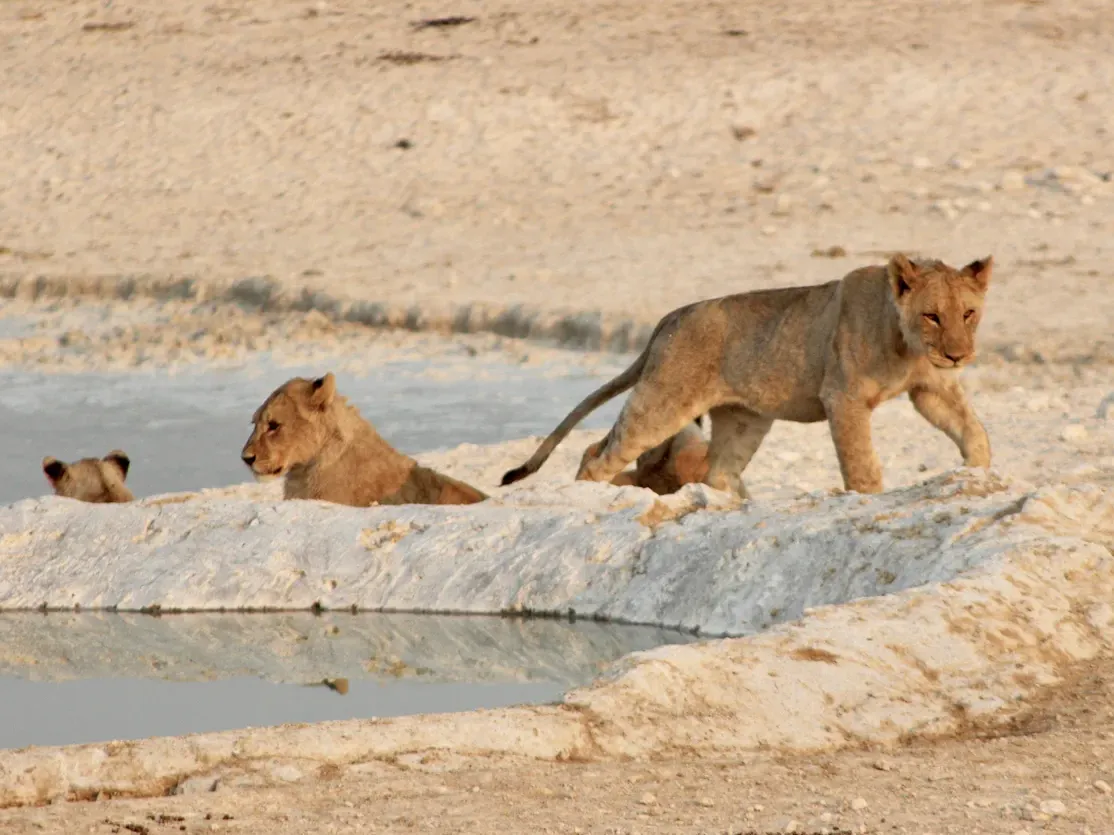
• Transport in a custom-built safari vehicle with USB charging capabilities & air-conditioning for the first 3 days
• Services of a professional English-speaking guide for the first 3 days
• 5 nights’ accommodation in twin share rooms with en-suite bathrooms as above
• Meals as above (B – breakfast, L – lunch, D – dinner)
• National Park entry fees (2 days Etosha)
• ½ day game drives as above in the Chameleon vehicle
• Full-day game drive in an open game viewer
• Boat Cruise at Walvis Bay
• Sandwich Harbour Activity
• Pick up and drop off within Windhoek city limits
• Shared airport shuttles to and from Windhoek International Airport (HKIA)
• Tap water


Pickup info: Pick up from accommodation starts at 7h00 on morning of departure

Other Info:
Bookings are made on a twin share basis, single supplement is available for solo travellers that prefer their own room 

Namibian Highlights

Starts: Windhoek International Airport
Ends: Windhoek International Airport
from N$46,800 (US $2,916)

This 7-day, 6-night accommodated safari is a tailor-made opportunity to experience the best of Namibia within a perfect time frame. Experience a moving insight into wildlife conservation and rehabilitation at the N/a’an ku se Wildlife Sanctuary before seeking spectacular wildlife encounters in Etosha National Park. We are looking for predators and prey alike.
Visit the mineral pan ’The Great White Space’ from which Etosha takes its name, a 22,000-square-kilometre desolate, dazzling expanse so vast that it can be seen from space.

Beautiful Damaraland gives us a unique ‘’Big Sky’’ experience, where the towering pink granite koppies seem to touch the very sky on our horizon, putting real meaning into the words ‘’breathtaking’’.
Meet some of the locals as we travel through Damaraland, Himba, Herero & Damara people, often in traditional dress, who welcome us to their makeshift roadside stalls under the shadow of Namibia’s highest mountain, The Brandberg.

Reaching the wild and rugged Skeleton Coast, we follow the ocean road into the unusual and quirky town of Swakopmund. Referred to by some as the adrenaline capital of Namibia, there are certainly some hair-raising experiences on offer, but Swakopmund is also a place where you can relax and recharge.

We head across the Tropic of Capricorn for an adventure on a magical trip to one of the most beautiful places on Planet Earth, the centre of the Namib – the world’s oldest desert. A pre-dawn start to catch the soft light as we head for Dead Vlei with its stark collection of skeleton trees and on to Sossusvlei, the water’s end of an ancient river. We watch out for wildlife; oryx and springbok are often seen in this sandy land

Day 1: Windhoek Airport – Chameleon Backpackers, Windhoek City Centre – 50 km
You will be collected from Windhoek’s Hosea Kutako International Airport and transferred to Chameleon Backpackers Lodge close to the centre of Windhoek City. After checking in and having some time to relax, clients who have arrived in Windhoek before 12:00 midday are in for an interesting and exciting afternoon excursion.

We will drive out to the internationally known N/a’an ku se Wildlife Sanctuary. It is located approximately 50 km east of Windhoek. N/a’an ku se is a sanctuary dedicated to the rehabilitation of sick, injured and orphaned animals. The ultimate goal is to reintroduce these sometimes rare and endangered species back into their natural habitat, allowing them to live life wild and free. Sadly, though, in numerous instances this is not possible. Some of the animals that come to N/a’an ku se would not, ever again, be able to fend for themselves in their native yet cruel natural environment. Instead, they take ‘’early retirement’’ and find themselves a permanent home at N/a’an ku se. We will be introduced to several species, perhaps baboon, caracal, lion & cheetah. Wild dog and leopard are also living at N/a’an ku se together with a multitude of smaller mammals, and we can watch some of the N/a’an ku se ’locals’ have their supper. Returning to Windhoek in the late afternoon. Dinner tonight is for your own account, but your guide will be able to make bookings and recommendations for you from the many excellent restaurants available in Namibia’s capital city.

Accommodation: Twin share, en-suite bathroom
Meals: no meals

Day 2: Windhoek – Camp inside Etosha National Park – 500 km
You will be collected from your accommodation within the Windhoek city limits at 07:00 and transferred to Chameleon Headquarters for a short pre-departure meeting.

Heading north from Windhoek, we stop briefly at the small town of Otjiwarongo to gather some last-minute supplies before continuing to Etosha, and we enjoy a light lunch pack whilst “on the move”. We enter Etosha National Park and embark on a game drive to our overnight accommodation.
Etosha is huge, spanning just over 22,000 square kilometres and home to 114 species of mammal, 350 species of bird, 110 species of reptile, countless numbers of insects, and, somewhat bizarrely, one species of fish. There are good chances of spotting many of these different creatures as we tour through the park, stopping at the various waterholes along the way.
All visitors must be in camp by sunset. We aim to arrive at our lodge before sunset, with time to settle into our rooms, which feature en-suite bathrooms and tea/coffee facilities. Dinner is at the camp restaurant tonight.

The ‘game show’ in Etosha doesn’t stop when the sun goes down. All the Etosha camps have floodlit waterholes for extra game viewing opportunities. The waterhole is located near our accommodation. A visit, or two, is highly recommended this evening, as we can expect many species to visit during the night. This waterhole is renowned for its popularity with elephants and the critically endangered black rhino.

Accommodation: Twin share, en-suite bathroom (Okaukuejo or Halali Resort)
Meals: Breakfast, Lunch, Dinner

Day 3: Etosha National Park –Accommodation near Anderson gate – 70 km
We have the whole day to explore Etosha, and we want to make the most of it. We enjoy an early breakfast and then start our day. The rest of the day, we explore the park with our guide on an open game viewer. Early morning is usually a productive time for game viewing, and first thing in the morning is a good time to catch big cats returning from the hunt.

Etosha is a desert landscape, and water is the most scarce natural resource. There are, however, numerous waterholes here, both natural and man-made, and our game-driving technique is to take in as many of these as possible. Here, we hope that the game will come to us as thirsty animals await a much-needed drink.

On our way today, we will stop to have a closer look at the Etosha Pan. The name Etosha translates as ‘great white space’, but this name does not do justice to the immensity of the pan. Over 4,700 square km of dazzling white mineral pan, so big that it can be seen from space. We exit Etosha at the Anderson gate, close to sunset, and it is just a short drive to our accommodation, which features a comfortable, spacious twin-share room with modern en-suite bathroom facilities. An ideal space to sit back, relax and enjoy the beauty that surrounds you. A fantastic dinner tonight.

Accommodation: Twin share, en-suite bathroom (Etosha Village, Okutala Etosha Lodge)
Meals: Breakfast, Lunch, Dinner

Day 4: Etosha – Swakopmund, – 510 km
After breakfast, we aim to be on the road by 7:30 this morning. We are heading for the Skeleton Coast, and we are taking the scenic route. We first head south on the main road, passing the small town of Outjo, and then continue west, picking up the gravel road as we travel through the area known as Damaraland.

Damaraland is renowned for its stunning scenery, majestic mountains, vast open grasslands, and tall koppies (small hills) of rounded pink granite boulders, as well as its expansive landscapes and vast blue skies. We also have the opportunity to meet some of the locals, as there are several places along our route today where we can find informal shops selling locally made, handcrafted souvenirs. Represented here are ladies from the Himba, Herero, and Damara tribes, and most often, they are wearing their traditional attire. Here we can interact with some of the colourful local characters who live in this harsh environment. Making a small purchase here is a good way to inject some cash directly into the local economy. We continue through the beautiful landscape, making a stop for a light picnic lunch, under the shadow of Namibia’s highest mountain, the Brandberg. Rising from the desert floor, this giant monolith is 2,573 m above sea level and is formed of pink-tinged granite.

We continue our journey west and soon arrive at the coast, where we encounter the chilly Atlantic Ocean. The whole coastline of Namibia is known as the Skeleton Coast, and it is easy to see why this barren seaboard is so named, with its forbidding mountains and barren beaches. The wind, the waves and the giant fog banks all conspire to push ships onto the beach. The countless mariners who, in olden times, found themselves shipwrecked here faced the stark prospect of no fresh water, no food, no rescue and a slow death by exposure. Their Shipmates who went down with their ship were thought to be the lucky ones.
Heading south on the coast road, our next stop is a more recent shipwreck. 15 km south of the small town of Henties Bay, a fishing trawler, The Zeila, was beached in 2008. She was an old vessel that had been sold for scrap and was under tow at the time. The cable snapped, and, like so many ships before her, she was caught in the swell and currents and ended up on the beach. She lies pretty close to the shore and is well-positioned for photos.

We complete the final leg of our journey to Swakopmund and check into our accommodation, which is centrally located, allowing us to explore the town on foot from our base easily. Swakopmund was founded by Captain Kurt von François of the German Empire’s imperial colonial army in 1892. (He also founded Windhoek in 1890). It is an interesting town to say the least, bounded to the north, the east and the south by the mighty dunes of the Namib Desert and to the west by the Atlantic Ocean. There are still many examples of colonial German architecture to be seen, and the German language remains widely spoken.
Swakopmund boasts some truly excellent restaurants, and again, your guide will be able to provide recommendations and assist with bookings.

Accommodation: Twin share, en-suite bathroom
Meals: Breakfast, Lunch

Day 5: Swakopmund – Accommodation, near Sesriem – 350 km
We have the option to start this morning more leisurely, as we won’t be leaving Swakopmund until late morning.

If you choose not to have a lie-in, then Swakopmund offers many opportunities to keep us busy during our morning here. The town centre is small and easily explored on foot, but there are also many extra, optional activities available. For those with a love of adrenaline, quad biking and sandboarding are very popular if you fancy careening down the slip face of a dune at 60 km per hour. Our guide will discuss all the options with you in advance and will be able to facilitate any bookings that we would like to make.
Departing Swakopmund at 11h30, we head east into the desert. We first cross the Namib gravel plains, large areas of flat and seemingly barren terrain broken up by huge mountain inselbergs. We have two mountain passes to traverse this afternoon, the first is the mighty Kuiseb Pass, and we follow the road from the top of the hills, dropping steeply down into the canyon carved over aeons by the Kuiseb River on its way to debouch into the ocean at the port town of Walvis Bay.
We climb up from the banks of the river and over the pass, travelling through the mountain peaks and on to the second, smaller canyon of the Gaub River, a tributary of the Kuiseb. We emerge from the mountains onto a flat road, and almost immediately we cross the Tropic of Capricorn at 23.5 degrees south. There is a signpost at this auspicious spot, and we stop along the road for photos.
From here, we continue through the desert landscape to the tiny town of Solitaire, where we can stretch our legs. Onwards again to our accommodation for the next two nights. Overnight is in twin rooms with en-suite bathroom facilities. There is a pool and bar available as well as a buffet dinner tonight.

Accommodation: Twin share, en-suite bathroom (Desert Camp, Desert Quiver Camp)
Meals: Breakfast, Lunch, Dinner

Day 6: Sossusvlei – 120 km
Getting into the dune area as early as possible this morning is the aim, and that means a pre-dawn start and a very early breakfast. As we are staying outside the national park, we will enter the dune area as soon as the gate opens at sunrise.
The best time to photograph the dunes is around sunrise and sunset. This is when you can see towering dunes illuminated a glowing orange, apricot red on one side and swathed in shadow on the other. The depth of field is terrific at this time of day. From Sesriem, we cover the 60 km into the dunes quickly and arrive at the 2×4 car park where all 2-wheel drive vehicles have to stop. From here, we enter the ancient Tsauchab River-bed for the last 5km leg to Sossusvlei itself.

The Tsauchab River is ephemeral; it only flows seasonally, when there is enough rain, and for the most part, the river-bed is dry. Aeons ago, during these rare floods, the Tsauchab sometimes received enough water to flow all the way to the Atlantic Ocean. However, as the millennia passed and the dune fields began to form (around five million years ago), wind-blown sand invaded the river-beds. The rivers became more and more constricted by sand until eventually the occasional floods could not break through the sand barriers that the wind had erected. The valley we drove along this morning to get here is kept free of sand by the Tsauchab, but Sossusvlei is now at the end of the water. Sossusvlei does still occasionally flood (perhaps once every decade). After good rains in the Naukluft Mountains, where the river originates, Sossusvlei can become inundated, and the resulting lake can persist for many months. However, the river can no longer find its original path to the Atlantic.

There is a 4×4 shuttle service that will transport us through the sandy terrain of the riverbed.
We will visit Dead Vlei, an ancient pan surrounded by dunes, which is strikingly populated with dead, skeletal camel thorn trees. These trees have been a feature of this landscape for over 1000 years. Dunes almost surround Sossusvlei; just one narrow path, kept open by the Tsauchab River, remains. We have time to explore the area on foot and climb one of the highest dunes in the world, some of which tower 300 m above us; the views are breathtaking and justly famous.

We drive back the way we came (there is only one road), stopping at the iconic Dune 45 (so named as it is 45 km from Sesriem). There is time to climb Dune 45 if you still have energy, or perhaps just sitting in the shade at the base of the dune will suffice.
Driving back to Sesriem, we take a short excursion to see the Sesriem Canyon. Only four km from Sesriem, this canyon has been carved out of the landscape by the Tsauchab River. Approximately two million years ago, a period of intense cold known as an ice age occurred in Europe. This caused glaciers to form and led to a global decline in sea level. The knock-on effect of this at Sesriem Canyon was that it increased the length and water flow of the Tsauchab River. This greater force of water allowed the Tsauchab to begin cutting through the terrain, resulting in the canyon we can see today. We can easily walk into the river-bed, it is usually much cooler in the canyon, and we can follow the river for some way along its journey to Sossusvlei.

We head back to our accommodation in the late afternoon.

Accommodation: Twin share, en-suite bathroom(Desert Camp, Desert Quiver Camp)
Meals: Breakfast, Lunch, Dinner

Day 7: Namib Desert – Windhoek – 320 km
Today is our last day, but excitement is still on the menu. We head back to Solitaire, where our guide will get us a sample of the apple pie that has made this homestead famous.
There is some lovely mountain scenery on our drive back to Windhoek. The road climbs up onto and over Namibia’s central plateau, and we return to Windhoek via the small community of BűellsPort and the small town of Rehoboth. We arrive mid-afternoon and will be dropped at Chameleon Backpackers or the accommodation of our choice within Windhoek city limits.

Accommodation: None
Meals: Breakfast
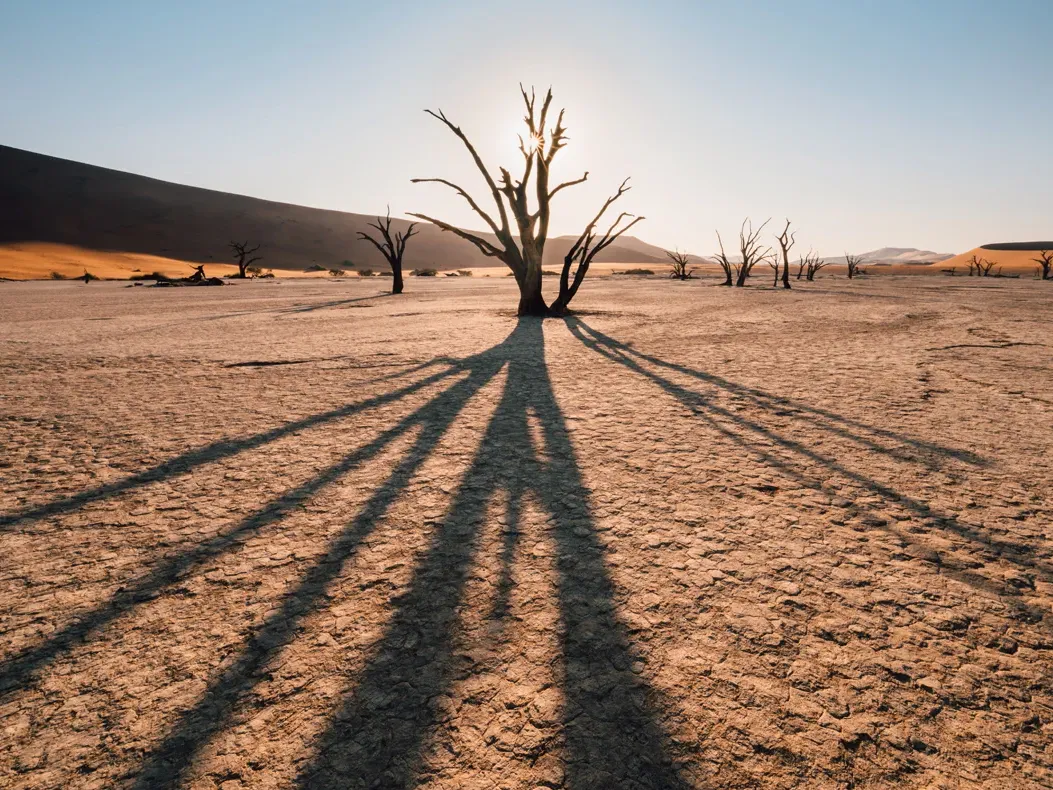
For those who choose to fly today, NO FLIGHTS DEPARTING BEFORE 19H00 in case of unexpected delays are returning from safari.

• Transport in a safari vehicle with USB charging ports and air conditioning
• English-speaking driver/guide
• 6 nights’ accommodation
• Meals (B x6, L x5, D x4)
• National Park entry fees
• Discover the Routes of Naankuse
• 1/2 day game drives in Etosha in the Chameleon Safaris vehicle
• Full Day Game drive in an open vehicle
• Guided excursion to Sossusvlei
• Return Airport transfers

Pickup info: Pick up from Windhoek International Airport on day 1. Must arrive before 10h00 at the airport

Other Info:
Bookings are made on a twin share basis, single supplement is available for solo travellers that prefer their own room 

.

Taste of Namibia

Starts: Windhoek International Airport
Ends: Windhoek International Airport
7 Days : $2906

This 7-day, 6-night accommodated safari is a tailor-made opportunity to experience the best of Namibia within a perfect time frame. Experience a moving insight into wildlife conservation and rehabilitation at the N/a’an ku se Wildlife Sanctuary before seeking spectacular wildlife encounters in Etosha National Park. We are looking for predators and prey alike. Visit the mineral pan ’The Great White Space’, from which Etosha takes its name, which is 22,000 square km of desolate, dazzling expanse, so big it can be seen from space.
Beautiful Damaraland gives us a unique ‘’Big Sky’’ experience, where the towering pink granite koppies seem to touch the very sky on our horizon, putting real meaning into the words ‘’breathtaking’’.

Meet some of the locals as we travel through Damaraland, Himba, Herero & Damara people, often in traditional dress, who welcome us to their makeshift roadside stalls under the shadow of Namibia’s highest mountain, The Brandberg. Reaching the wild and rugged Skeleton Coast, we follow the ocean road into the unusual and quirky town of Swakopmund. Referred to by some as the adrenaline capital of Namibia, there are certainly some hair-raising experiences on offer, but Swakopmund is also a place where you can relax and recharge.

We head across the Tropic of Capricorn for an adventure on a magical trip to one of the most beautiful places on Planet Earth, the centre of the Namib – the world’s oldest desert. A pre-dawn start to catch the soft light of sunrise as we head for Dead Vlei with its stark collection of skeleton trees and on to Sossusvlei, the water’s end of an ancient river. We watch out for wildlife, oryx and springbok are often seen in this sandy land. Then homeward-bound up-and-over Rocky Mountains as we climb our way up the central plateau and across the Khomas Hochland mountains to Windhoek

Day 1: Windhoek Airport – Hilton Hotel, Windhoek City Centre – 50 km
You will be collected from Windhoek’s Hosea Kutako International Airport and transferred to the luxurious Hilton Hotel located in the heart of Windhoek City. After checking in and having some time to relax, clients who have arrived in Windhoek before 12:00 midday are in for an interesting and exciting afternoon excursion. Please ensure that if your flight is today, you land at the International Airport before 10:00 to arrive in Windhoek by 12:00.

We will drive out to the internationally known N/a’an ku se Wildlife Sanctuary. Located about 50 km to the east of Windhoek. N/a’an ku se is a sanctuary dedicated to the rehabilitation of sick, injured and orphaned animals. The ultimate goal is to reintroduce these sometimes rare and endangered species back into their natural habitat, allowing them to live life wild and free. Sadly, though, in numerous instances, this is not possible. Some of the animals that come to N/a’an ku se would not, ever again, be able to fend for themselves in their native yet cruel natural environment. Instead, they take ‘’early retirement’’ and find themselves a permanent home at N/a’an ku se. We will be introduced to several species, perhaps baboon, caracal, lion & cheetah. Wild dog and leopard are also living at N/a’an ku se together with a multitude of smaller mammals, and we can watch some of the N/a’an ku se ’locals’ have their supper.
Returning to Windhoek in the late afternoon. Dinner tonight is for your own account from the many excellent restaurants available in Namibia’s capital city.

Accommodation: Twin share, en-suite bathroom
Meals: None

Day 2: Windhoek – Lodge inside Etosha National Park – 500 km
You will be collected from your accommodation within the Windhoek city limits at 07:00 and transferred to Chameleon Headquarters for a short pre-departure meeting.

Heading north from Windhoek, we stop briefly at the small town of Otjiwarongo to gather some last-minute supplies before continuing to Etosha, and we enjoy a light lunch pack whilst “on the move”. We enter Etosha National Park and embark on a game drive to our overnight accommodation.
Etosha is huge, spanning just over 22,000 square kilometres and home to 114 species of mammal, 350 species of bird, 110 species of reptile, countless numbers of insects, and, somewhat bizarrely, one species of fish. There are good chances of spotting many of these different creatures as we tour through the park, stopping at the various waterholes along the way. All visitors must be in camp by sunset. We aim to arrive at our lodge before sunset, allowing time to settle into our rooms, which feature en-suite bathrooms. Dinner is at the camp restaurant tonight.

The ‘game show’ in Etosha doesn’t stop when the sun goes down. All the Etosha camps have floodlit waterholes for extra game viewing opportunities. The waterhole is located near our accommodation. A visit, or two, is highly recommended this evening, as we can expect many species to visit during the night. This waterhole is renowned for its popularity with elephants and the critically endangered black rhino.

Accommodation: Twin share, en-suite bathroom (Okaukuejo or Halali Resort)
Meals: Breakfast, Lunch, Dinner

Day 3: Etosha National Park-Accommodation near Anderson gate – 70 km
We have the whole day to explore Etosha, and we want to make the most of it. We enjoy an early breakfast and then start our day. The rest of the day, we explore the park with our guide on an open game viewer. Early morning is usually a productive time for game viewing, and first thing in the morning is a good time to catch big cats returning from the hunt.

Etosha is a desert landscape, and water is the most scarce natural resource. There are, however, numerous waterholes here, both natural and man-made, and our game-driving technique is to take in as many of these as possible. Here, we hope that the game will come to us as thirsty animals await a much-needed drink. On our way today, we will stop to have a closer look at the Etosha Pan. The name Etosha translates as ‘great white space’, but this name does not do justice to the immensity of the pan. Over 4,700 square km of dazzling white mineral pan, so big that it can be seen from space.

We exit Etosha at the Anderson Gate, just before sunset, and it’s a short drive to our accommodation, which features a comfortable, spacious twin-share room with modern en-suite bathroom facilities. An ideal space to sit back, relax and enjoy the beauty that surrounds you. A fantastic dinner tonight.

Accommodation: Twin share, en-suite bathroom (Etosha Village, Okutala Etosha Lodge)
Meals: Breakfast, Lunch, Dinner

Day 4: Etosha – Swakopmund – 510 km
After breakfast, we aim to be on the road by 7:30 this morning. We are heading for the Skeleton Coast, and we are taking the scenic route. We first head south on the main road, passing the small town of Outjo, and then continue west, picking up the gravel road as we travel through the area known as Damaraland.
Damaraland is renowned for its stunning scenery, majestic mountains, vast open grasslands, and tall koppies (small hills) of rounded, pink granite boulders, as well as its expansive landscapes and vast, open skies. We also have the opportunity to meet some of the locals, as there are several places along our route today where we can find informal shops selling locally made, handcrafted souvenirs. Represented here are ladies from the Himba, Herero, and Damara tribes, and most often, they are wearing their traditional attire. Here we can interact with some of the colourful local characters who live in this harsh environment. Making a small purchase here is a good way to inject some cash directly into the local economy. We continue through the beautiful landscape, making a stop for a light picnic lunch, under the shadow of Namibia’s highest mountain, the Brandberg. Rising from the desert floor, this giant monolith is 2,573 m above sea level and is formed of pink-tinged granite.
We continue our journey west and soon arrive at the coast, where we encounter the chilly Atlantic Ocean. The whole coastline of Namibia is known as the Skeleton Coast, and it is easy to see why this barren seaboard is so named, with its forbidding mountains and barren beaches. The wind, the waves and the giant fog banks all conspire to push ships onto the beach. The countless mariners who, in olden times, found themselves shipwrecked here faced the stark prospect of no fresh water, no food, no rescue and a slow death by exposure. Their Shipmates who went down with their ship were thought to be the lucky ones.
Heading south on the coast road, our next stop is a more recent shipwreck. 15 km south of the small town of Henties Bay, a fishing trawler, The Zeila, was beached in 2008. She was an old vessel that had been sold for scrap and was under tow at the time. The cable snapped, and, like so many ships before her, she was caught in the swell and currents and ended up on the beach. She lies pretty close to the shore and is well-positioned for photos.
We complete the final leg of our journey to Swakopmund and check into our accommodation, which is centrally located, allowing us to explore the town on foot from our base easily. Swakopmund was founded by Captain Kurt von François of the German Empire’s imperial colonial army in 1892. (He also founded Windhoek in 1890). It is an interesting town to say the least, bounded to the north, the east and the south by the mighty dunes of the Namib Desert and to the west by the Atlantic Ocean. There are still many examples of colonial German architecture to be seen, and the German language remains widely spoken.
Swakopmund boasts some truly excellent restaurants, and again, your guide will be able to provide recommendations and assist with bookings.

Accommodation: Twin share, en-suite bathroom
Meals: Breakfast, Lunch,

Day 5: Swakopmund – Accommodation near Sesriem – 350 km
We have the option to start this morning more leisurely, as we won’t be leaving Swakopmund until late morning.

If you choose not to have a lie-in, then Swakopmund offers many opportunities to keep us busy during our morning here. The town centre is small and easily explored on foot, but there are also many extra, optional activities available. For those with a love of adrenaline, quad biking and sandboarding are extremely popular, offering the thrill of careening down the slip face of a dune at speeds of up to 60 km/h. Our guide will discuss all the options with you in advance and will be able to facilitate any bookings that we would like to make.

Departing Swakopmund at 11h30, we head east into the desert. We first cross the Namib gravel plains, large areas of flat and seemingly barren terrain broken up by huge mountain inselbergs. We have two mountain passes to traverse this afternoon, the first is the mighty Kuiseb Pass, and we follow the road from the top of the hills, dropping steeply down into the canyon carved over aeons by the Kuiseb River on its way to debouch into the ocean at the port town of Walvis Bay.

We climb up from the banks of the river and over the pass, travelling through the mountain peaks and on to the second, smaller canyon of the Gaub River, a tributary of the Kuiseb. We emerge from the mountains onto a flat road, and almost immediately we cross the Tropic of Capricorn at 23.5 degrees south. There is a signpost at this auspicious spot, and we stop along the road for photos.
From here, we continue through the desert landscape to the tiny town of Solitaire, where we can stretch our legs and sample the apple pie that has made this homestead famous. Onwards again to our accommodation for the next two nights.
Overnight is in twin rooms with en-suite bathroom facilities. There is a pool and bar available as well as a buffet dinner tonight.

Accommodation: Twin share, en-suite bathroom(Desert Camp, Desert Quiver Camp)
Meals: Breakfast, Lunch, Dinner

Day 6: Sossusvlei – 120 km
Getting into the dune area as early as possible this morning is the aim, and that means a pre-dawn start and a very early breakfast. As we are staying outside the National Park, we will enter the dune area as soon as the gate opens at sunrise.
The best time to photograph the dunes is around sunrise and sunset. This is when you can see towering dunes illuminated a glowing orange, apricot red on one side and swathed in shadow on the other. The depth of field is spectacular at this time of day. From Sesriem, we cover the 60 km into the dunes quickly and arrive at the 2×4 car park where all 2-wheel drive vehicles have to stop. From here, we enter the ancient Tsauchab River-bed for the last 5km leg to Sossusvlei itself.
The Tsauchab River is ephemeral; it only flows seasonally, when there is enough rain, and for the most part, the river-bed is dry. Aeons ago, during these rare floods, the Tsauchab sometimes received enough water to flow all the way to the Atlantic Ocean. However, as the millennia passed and the dune fields began to form (around five million years ago), wind-blown sand invaded the river-beds. The rivers became more and more constricted by sand until eventually the occasional floods could not break through the sand barriers that the wind had erected. The valley we drove along this morning to get here is kept free of sand by the Tsauchab, but Sossusvlei is now at the end of the water.
Sossusvlei still occasionally floods (perhaps once every decade). After good rains in the Naukluft Mountains, where the river originates, Sossusvlei can become inundated, and the resulting lake can persist for many months. However, the river can no longer find its original path to the Atlantic. There is a 4×4 shuttle service that will transport us through the sandy terrain of the riverbed.
We will visit Dead Vlei, an ancient pan surrounded by dunes, which is strikingly populated with dead, skeletal camel thorn trees. These trees have been a feature of this landscape for over 1000 years. Dunes almost surround Sossusvlei; just one narrow path, kept open by the Tsauchab River, remains. We have time to explore the area on foot and climb one of the highest dunes in the world, some of which tower 300 m above us; the views are breathtaking and justly famous.
We drive back the way we came (there is only one road), stopping at the iconic Dune 45 (so named as it is 45 km from Sesriem. There is time to climb Dune 45 if you still have energy, or perhaps just sitting in the shade at the base of the dune will suffice.
Driving back to Sesriem, we take a short excursion to see the Sesriem Canyon. Only four km from Sesriem, this canyon has been carved out of the landscape by the Tsauchab River. Approximately two million years ago, a period of intense cold known as an ice age occurred in Europe. This caused glaciers to form and led to a global decline in sea level. The knock-on effect of this at Sesriem Canyon was that it increased the length and water flow of the Tsauchab River. This greater force of water allowed the Tsauchab to begin cutting through the terrain, resulting in the canyon we can see today. We can easily walk into the river-bed, it is usually much cooler in the canyon, and we can follow the river for some way along its journey to Sossusvlei.

We head back to our accommodation in the late afternoon.

Accommodation: Twin share, en-suite bathroom(Desert Camp, Desert Quiver Camp)
Meals: Breakfast, Lunch, Dinner

Day 7: Namib Desert – Windhoek – 320 km
Today is our last day, but excitement is still on the menu. We head back to Solitaire, where our guide will get us a sample of the apple pie that has made this homestead famous.
There is some lovely mountain scenery on our drive back to Windhoek. The road climbs up onto and over Namibia’s central plateau, and we return to Windhoek via the small community of BűellsPort and the small town of Rehoboth. We arrive mid-afternoon and will be dropped off at Chameleon Backpackers or the accommodation of our choice within Windhoek city limits.

Accommodation: None
Meals: Breakfast
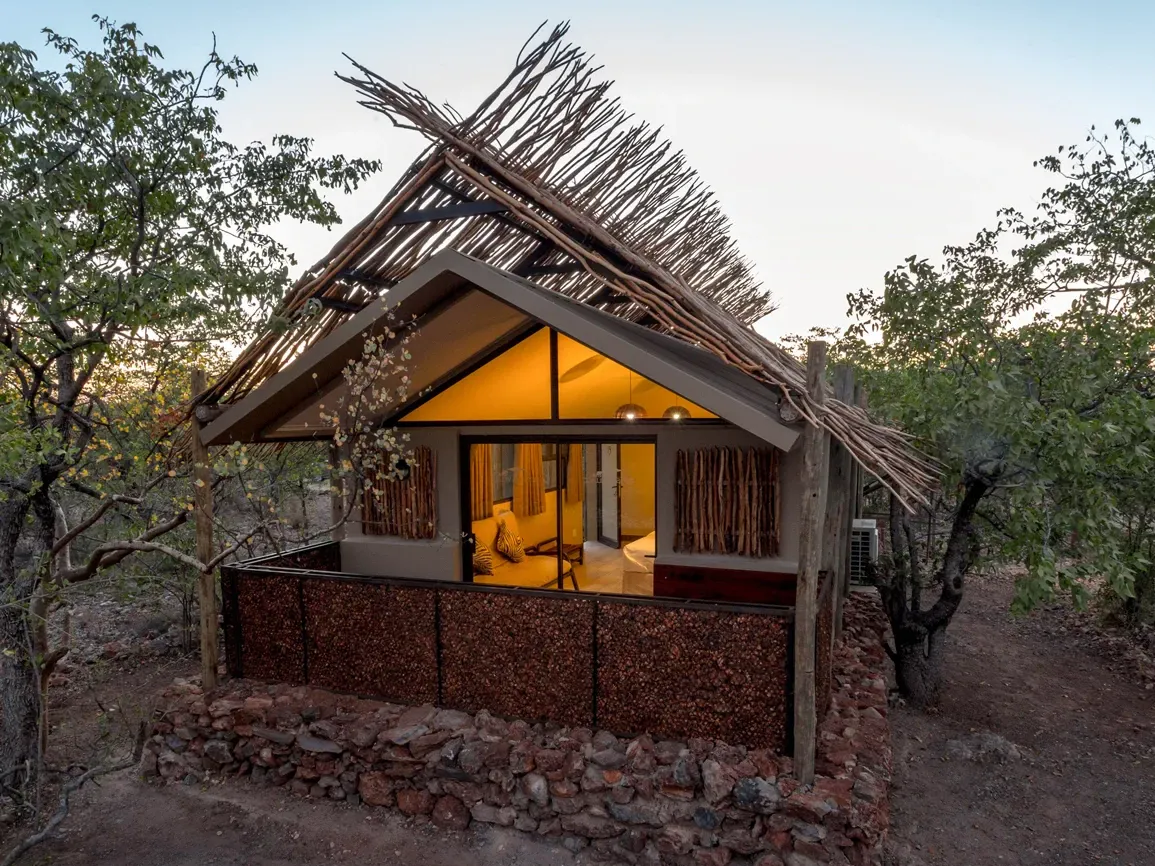
For those who choose to fly today, we will transfer you to Windhoek’s international airport. NO FLIGHTS DEPARTING BEFORE 19H00 should be booked in case of unexpected delays returning from safari.

• Transport in a safari vehicle with USB charging ports and air conditioning
• English-speaking driver/guide
• 6 nights’ accommodation
• Meals (B x6, L x5, D x4)
• National Park entry fees
• Discover the Routes of Naankuse
• 1/2 Day Game drives in Etosha in the Chameleon Safaris Vehicle
• Full Day Game drive in an open Game viewer
• Guided excursion to Sossusvlei
• Return Airport transfers


Pickup info: Pick up from Windhoek International Airport on day 1. Must arrive prior to 10h00

Other Info:
Bookings are made on a twin share basis, single supplement is available for solo travellers that prefer their own room 


Mobirise Website Builder
About

Our company was founded due to a lifelong passion and love for the beautiful rhythm of Africa and its people.